


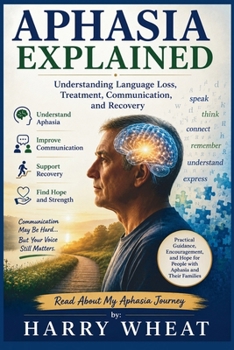
Aphasia Explained: Understanding Language Loss, Treatment, Communication, and Recovery
No Customer Reviews

Introduction
Communication is one of the most important parts of being human.
Through language, we tell people what we need. We share memories. We ask questions. We make decisions. We tell jokes, express love, explain pain, discuss our beliefs, and connect with the people around us.
Most people rarely think about how complicated language is until something goes wrong.
Aphasia can suddenly make ordinary communication difficult.
A person may know exactly what they want to say but be unable to find the words. Another person may speak fluently yet use words that do not communicate the intended message. Some people understand conversation well but cannot produce complete sentences. Others have difficulty understanding speech, reading, writing, or several forms of language at once.
For many people, aphasia begins after a stroke.
For others, it follows a traumatic brain injury, brain surgery, infection, tumor, or neurological disease.
Whatever the cause, the experience can be frightening.
Families may wonder whether their loved one still understands them.
The person with aphasia may wonder whether communication will ever become easier.
Friends may become uncomfortable because they do not know what to say or how long to wait for an answer.
Healthcare appointments, restaurants, telephone calls, family gatherings, and even simple conversations can suddenly become exhausting.
This book was written to make aphasia easier to understand.
The chapters ahead explain what aphasia is, how the brain produces language, what can cause aphasia, the major patterns of language difficulty, how aphasia is diagnosed, and how speech and language therapy can help.
You will also learn practical communication strategies that can be used at home and in the community.
Special attention is given to family members and caregivers because communication recovery does not happen only inside a therapy room. The way relatives, friends, and caregivers communicate can make an enormous difference in whether a person with aphasia feels included or isolated.
This book also discusses the emotional side of aphasia.
The loss of easy communication can affect confidence, relationships, work, independence, and social life. Frustration, loneliness, anxiety, and sadness deserve attention alongside speech and language rehabilitation.
Most importantly, this book is built around one central message:
Aphasia affects communication, but it does not erase the person.
Someone who struggles to speak may still think deeply.
Someone who cannot find a name may still recognize the person they love.
Someone who needs pictures or gestures may still have important opinions, preferences, humor, faith, memories, and dreams.
The goal of recovery is therefore larger than producing perfect sentences.
It is helping a person participate in life.
It is helping them make choices.
It is helping families reconnect.
It is finding a way for the person's voice-spoken, written, gestured, pictured, or assisted by technology-to continue being heard.
Recovery may be fast for some and slow for others. Some people regain much of their language. Others continue living with aphasia and become highly skilled at using alternative communication strategies.
There is no single recovery story.
There is, however, room for progress.
There is room for adaptation.
There is room for connection.
And there is room for hope.
Communication is one of the most important parts of being human.
Through language, we tell people what we need. We share memories. We ask questions. We make decisions. We tell jokes, express love, explain pain, discuss our beliefs, and connect with the people around us.
Most people rarely think about how complicated language is until something goes wrong.
Aphasia can suddenly make ordinary communication difficult.
A person may know exactly what they want to say but be unable to find the words. Another person may speak fluently yet use words that do not communicate the intended message. Some people understand conversation well but cannot produce complete sentences. Others have difficulty understanding speech, reading, writing, or several forms of language at once.
For many people, aphasia begins after a stroke.
For others, it follows a traumatic brain injury, brain surgery, infection, tumor, or neurological disease.
Whatever the cause, the experience can be frightening.
Families may wonder whether their loved one still understands them.
The person with aphasia may wonder whether communication will ever become easier.
Friends may become uncomfortable because they do not know what to say or how long to wait for an answer.
Healthcare appointments, restaurants, telephone calls, family gatherings, and even simple conversations can suddenly become exhausting.
This book was written to make aphasia easier to understand.
The chapters ahead explain what aphasia is, how the brain produces language, what can cause aphasia, the major patterns of language difficulty, how aphasia is diagnosed, and how speech and language therapy can help.
You will also learn practical communication strategies that can be used at home and in the community.
Special attention is given to family members and caregivers because communication recovery does not happen only inside a therapy room. The way relatives, friends, and caregivers communicate can make an enormous difference in whether a person with aphasia feels included or isolated.
This book also discusses the emotional side of aphasia.
The loss of easy communication can affect confidence, relationships, work, independence, and social life. Frustration, loneliness, anxiety, and sadness deserve attention alongside speech and language rehabilitation.
Most importantly, this book is built around one central message:
Aphasia affects communication, but it does not erase the person.
Someone who struggles to speak may still think deeply.
Someone who cannot find a name may still recognize the person they love.
Someone who needs pictures or gestures may still have important opinions, preferences, humor, faith, memories, and dreams.
The goal of recovery is therefore larger than producing perfect sentences.
It is helping a person participate in life.
It is helping them make choices.
It is helping families reconnect.
It is finding a way for the person's voice-spoken, written, gestured, pictured, or assisted by technology-to continue being heard.
Recovery may be fast for some and slow for others. Some people regain much of their language. Others continue living with aphasia and become highly skilled at using alternative communication strategies.
There is no single recovery story.
There is, however, room for progress.
There is room for adaptation.
There is room for connection.
And there is room for hope.
Format:Paperback
Language:English
ISBN:B0HDMHYMYX
ISBN13:9798191791166
Release Date:August 2026
Publisher:Independently Published
Length:260 Pages
Weight:0.78 lbs.
Dimensions:0.6" x 6.0" x 9.0"
Customer Reviews
0 rating
Copyright © 2026 Thriftbooks.com
Terms of Use | Privacy Policy | Do Not Sell/Share My Personal Information | Cookie Policy | Cookie Preferences | Accessibility Statement
ThriftBooks ® and the ThriftBooks ® logo are registered trademarks of Thrift Books Global, LLC
ThriftBooks ® and the ThriftBooks ® logo are registered trademarks of Thrift Books Global, LLC
