


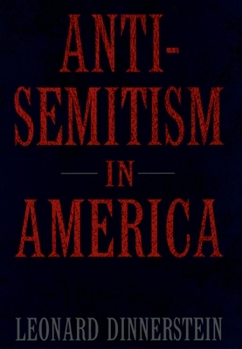
Antisemitism in America

Select Format
Select Condition 
Book Overview
Is antisemitism on the rise in America? Did the "hymietown" comment by Jesse Jackson and the Crown Heights riot signal a resurgence of antisemitism among blacks? The surprising answer to both questions, according to Leonard Dinnerstein, is no--Jews have never been more at home in America. But what we are seeing today, he writes, are the well-publicized results of a long tradition of prejudice, suspicion, and hatred against Jews--the direct product of the Christian teachings underlying so much of America's national heritage.
In Antisemitism in America, Leonard Dinnerstein provides a landmark work--the first comprehensive history of prejudice against Jews in the United States, from colonial times to the present. His richly documented book traces American antisemitism from its roots in the dawn of the Christian era and arrival of the first European settlers, to its peak during World War II and its present day permutations--with separate chapters on antisemititsm in the South and among African-Americans, showing that prejudice among both whites and blacks flowed from the same stream of Southern evangelical Christianity. He shows, for example, that non-Christians were excluded from voting (in Rhode Island until 1842, North Carolina until 1868, and in New Hampshire until 1877), and demonstrates how the Civil War brought a new wave of antisemitism as both sides assumed that Jews supported with the enemy. We see how the decades that followed marked the emergence of a full-fledged antisemitic society, as Christian Americans excluded Jews from their social circles, and how antisemetic fervor climbed higher after the turn of the century, accelerated by eugenicists, fear of Bolshevism, the publications of Henry Ford, and the Depression. Dinnerstein goes on to explain that just before our entry into World War II, antisemitism reached a climax, as Father Coughlin attacked Jews over the airwaves (with the support of much of the Catholic clergy) and Charles Lindbergh delivered an openly antisemitic speech to an isolationist meeting. After the war, Dinnerstein tells us, with fresh economic opportunities and increased activities by civil rights advocates, antisemititsm went into sharp decline--though it frequently appeared in shockingly high places, including statements by Nixon and his Chairman of the Joint Chiefs of Staff.
"It must also be emphasized," Dinnerstein writes, "that in no Christian country has antisemitism been weaker than it has been in the United States," with its traditions of tolerance, diversity, and a secular national government. This book, however, reveals in disturbing detail the resilience, and vehemence, of this ugly prejudice. Penetrating, authoritative, and frequently alarming, this is the definitive account of a plague that refuses to go away.
In Antisemitism in America, Leonard Dinnerstein provides a landmark work--the first comprehensive history of prejudice against Jews in the United States, from colonial times to the present. His richly documented book traces American antisemitism from its roots in the dawn of the Christian era and arrival of the first European settlers, to its peak during World War II and its present day permutations--with separate chapters on antisemititsm in the South and among African-Americans, showing that prejudice among both whites and blacks flowed from the same stream of Southern evangelical Christianity. He shows, for example, that non-Christians were excluded from voting (in Rhode Island until 1842, North Carolina until 1868, and in New Hampshire until 1877), and demonstrates how the Civil War brought a new wave of antisemitism as both sides assumed that Jews supported with the enemy. We see how the decades that followed marked the emergence of a full-fledged antisemitic society, as Christian Americans excluded Jews from their social circles, and how antisemetic fervor climbed higher after the turn of the century, accelerated by eugenicists, fear of Bolshevism, the publications of Henry Ford, and the Depression. Dinnerstein goes on to explain that just before our entry into World War II, antisemitism reached a climax, as Father Coughlin attacked Jews over the airwaves (with the support of much of the Catholic clergy) and Charles Lindbergh delivered an openly antisemitic speech to an isolationist meeting. After the war, Dinnerstein tells us, with fresh economic opportunities and increased activities by civil rights advocates, antisemititsm went into sharp decline--though it frequently appeared in shockingly high places, including statements by Nixon and his Chairman of the Joint Chiefs of Staff.
"It must also be emphasized," Dinnerstein writes, "that in no Christian country has antisemitism been weaker than it has been in the United States," with its traditions of tolerance, diversity, and a secular national government. This book, however, reveals in disturbing detail the resilience, and vehemence, of this ugly prejudice. Penetrating, authoritative, and frequently alarming, this is the definitive account of a plague that refuses to go away.
Format:Paperback
Language:English
ISBN:019510112X
ISBN13:9780195101126
Release Date:November 1995
Publisher:Oxford University Press
Length:400 Pages
Weight:1.33 lbs.
Dimensions:1.0" x 6.0" x 9.1"
Customer Reviews
2 ratings
An outstanding book
Published by Thriftbooks.com User , 27 years ago
I almost cried many times whie readiing this book. I am just thankful that i grew up in the 1970's-1980's when anti-semetism was at an alltime low. I can only imaging what jews hd to go thri in the first half of this Century. His chapter on black anti-semetism hit it on the head big time. He shows how black anti-semetirsm started an how they are the only group in america today who is still openly anti-semetic. This book is the most definitive book on anti-semetism that i have ever read
Good Reading
Published by Thriftbooks.com User , 28 years ago
Even though this book deals with an unpleasant subject, it is so well written that it is a pleasure to read it. The information contained in the book is valuable and appears to have been thoroughly researched.
Copyright © 2026 Thriftbooks.com Terms of Use
| Privacy Policy | Do Not
Sell/Share My Personal Information | Cookie Policy | Cookie Preferences | Accessibility Statement
ThriftBooks® and the ThriftBooks® logo are registered trademarks of Thrift Books Global, LLC
ThriftBooks® and the ThriftBooks® logo are registered trademarks of Thrift Books Global, LLC
