


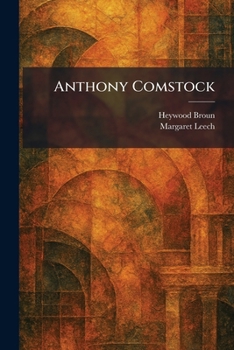
Anthony Comstock

"Anthony Comstock" is a compelling biography of the man who became the most notorious guardian of public morality in late 19th and early 20th-century America. Written by Heywood Broun and Margaret Leech, this work explores the life and influence of the founder of the New York Society for the Suppression of Vice and the namesake of the Comstock Laws. The book provides an in-depth look at his crusade against what he deemed obscene, focusing on his efforts to regulate literature, art, and personal conduct through strict legal measures.
The authors analyze Comstock's psychological motivations and his profound impact on American culture and legal standards. From his early days as a zealous activist to his position as a special agent for the United States Post Office, the narrative chronicles his relentless pursuit of vice and the controversies that surrounded his name. "Anthony Comstock" serves as a critical study of a figure who defined an era of moral reform and censorship. This biography remains a significant resource for understanding the tensions between individual freedom and social regulation in American history, offering insights into the complex legacy of a man who viewed himself as a soldier in a holy war against sin.
This work has been selected by scholars as being culturally important, and is part of the knowledge base of civilization as we know it. This work was reproduced from the original artifact, and remains as true to the original work as possible. Therefore, you may see the original copyright references, library stamps (as most of these works have been housed in our most important libraries around the world), and other notations in the work.
This work is in the public domain in the United States of America, and possibly other nations. Within the United States, you may freely copy and distribute this work, as no entity (individual or corporate) has a copyright on the body of the work.
As a reproduction of a historical artifact, this work may contain missing or blurred pages, poor pictures, errant marks, etc. Scholars believe, and we concur, that this work is important enough to be preserved, reproduced, and made generally available to the public. We appreciate your support of the preservation process, and thank you for being an important part of keeping this knowledge alive and relevant.
Customer Reviews
ThriftBooks ® and the ThriftBooks ® logo are registered trademarks of Thrift Books Global, LLC
