


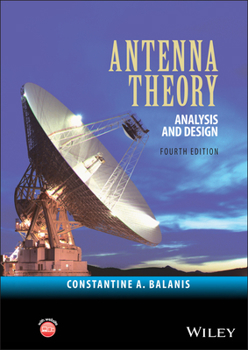
Antenna Theory: Analysis and Design

Select Format
Select Condition 
Book Overview
Updated with color and gray scale illustrations, a companion website housing supplementary material, and new sections covering recent developments in antenna analysis and design This book introduces the fundamental principles of antenna theory and explains how to apply them to the analysis, design, and measurements of antennas. Due to the variety of methods of analysis and design, and the different antenna structures available, the applications covered in this book are made to some of the most basic and practical antenna configurations. Among these antenna configurations are linear dipoles; loops; arrays; broadband antennas; aperture antennas; horns; microstrip antennas; and reflector antennas. The text contains sufficient mathematical detail to enable undergraduate and beginning graduate students in electrical engineering and physics to follow the flow of analysis and design. Readers should have a basic knowledge of undergraduate electromagnetic theory, including Maxwell's equations and the wave equation, introductory physics, and differential and integral calculus. Presents new sections on flexible and conformal bowtie, Vivaldi antenna, antenna miniaturization, antennas for mobile communications, dielectric resonator antennas, and scale modeling Provides color and gray scale figures and illustrations to better depict antenna radiation characteristics Includes access to a companion website housing MATLAB programs, Java-based applets and animations, Power Point notes, Java-based interactive questionnaires and a solutions manual for instructors Introduces over 100 additional end-of-chapter problems Antenna Theory: Analysis and Design, Fourth Edition is designed to meet the needs of senior undergraduate and beginning graduate level students in electrical engineering and physics, as well as practicing engineers and antenna designers. Constantine A. Balanis received his BSEE degree from the Virginia Tech in 1964, his MEE degree from the University of Virginia in 1966, his PhD in Electrical Engineering from The Ohio State University in 1969, and an Honorary Doctorate from the Aristotle University of Thessaloniki in 2004. From 1964 to 1970, he was with the NASA Langley Research Center in Hampton, VA, and from 1970 to 1983, he was with the Department of Electrical Engineering of West Virginia University. In 1983 he joined Arizona State University and is now Regents' Professor of Electrical Engineering. Dr. Balanis is also a life fellow of the IEEE.
Format:Hardcover
Language:English
ISBN:1118642066
ISBN13:9781118642061
Release Date:February 2016
Publisher:Wiley
Length:1104 Pages
Weight:5.30 lbs.
Dimensions:2.0" x 7.4" x 10.2"
Customer Reviews
5 ratings
A delightful read
Published by Thriftbooks.com User , 20 years ago
This is quite possibly one of the biggest books on antennas ever written. The information is presented in a clear and concise manner, and you can easily find what you need. There is all sorts of information on new antennas and the derivations for many equations are presented clearly. There is enough material to give all other books page envy, and therefore, it earns a rating of 5 stars.
Excellent
Published by Thriftbooks.com User , 20 years ago
I have two standard textbooks on antennas, namely, Antenna Theory by Balanis and Antennas by Kraus (both third edition). Both are good books. But if I could keep only one book, I would definitely choose Balanis because, in my non-expert opinion, it is more coherent, more systematic, and has a stronger emphasis on principles. Balanis also comes with a helpful CD containing Powerpoint slides (tons of them), Matlab files, and a few other items. The paper quality is superb but the paper thickness makes for a tome that feels like a heavy college dictionary. The mathematics is not as scary as I originally thought, and should be okay for final year EE undergraduates. I recommend this book highly and unreservedly.
Good text for self-study and antenna work
Published by Thriftbooks.com User , 25 years ago
I bought this book when I needed to analyze antennas in arrays in and found it very competent and logical. There are many things to like about it:1. comprehensive coverage of antenna types and analysis techniques2. Chapter 2 contains a nice compendium of definitions according to IEEE standards, with enough mathematical detail to make it useful in its own right.3. Good explanations of the material. It's not a cookbook (that's good!). Balanis provides clear text and derivations of the key results, with illustrations. He hasn't watered down the level of sophistication of his topics; they aren't at the research level, but they are fully at the level of the established state of the art.4) Error-free. I typically wrestle with a few errors or typos in a text as I repeat derivations or perform calcs in the course of my work. I haven't found any errors here so far.Coverage of the various antenna types is pretty standard. It's in discussions of topics like the Method of Moments, reciprocity, and self- and mutual- impedance, and the method of stationary phase where the book shines--they are clear, easy to follow, with sufficient detail to solve real problems.Shortcomings of the book are few, but include:a) sparse or no treatment of advanced topics such as scattering, array implementation, network approach (foster's reaction theorem, relation of mutual coupling to measured scattering parameters), etc.b) inclusion of Fortran (!) programs for the calculations. Matlab, Mathcad or just plain descriptions would be more useful. Puzzling since one Matlab file is included.I recommend this book heartily. Engineering practicality and mathematical rigor are balanced nicely. The lack of advanced topic coverage is easily made up by going to specialty texts or the research literature. It worked well for me as a self-study text, and should work for you too.
An excellent text on antennas
Published by Thriftbooks.com User , 26 years ago
Any one who have had an introductory course on electromagnetics may use this book either as a reference for an antenna design or as a perfect learning material. Balanis' clear, informative language, enhanced with many illustrations help the student to understand the subject easily. Due to its wide range of topics, the book is of invaluable help for an antenna designer. The diskette provided with the book includes FORTRAN codes for many practical design problems and frees the reader from complicated formulas. A must have for any enginneer involved in the subject!
Excellent
Published by Thriftbooks.com User , 26 years ago
This text has been a standard in graduate antenna theory classes for years. The first edition was also well written, but the author has reorganized some of the chapters and better explains some of the more advanced topics. This is the only text I'll ever use for my intro to antenna theory classes.
Copyright © 2026 Thriftbooks.com Terms of Use
| Privacy Policy | Do Not
Sell/Share My Personal Information | Cookie Policy | Cookie Preferences | Accessibility Statement
ThriftBooks® and the ThriftBooks® logo are registered trademarks of Thrift Books Global, LLC
ThriftBooks® and the ThriftBooks® logo are registered trademarks of Thrift Books Global, LLC
