


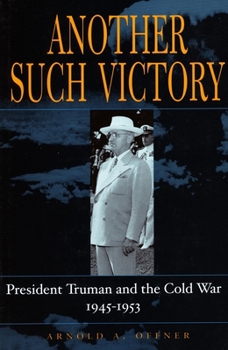
Another Such Victory: President Truman and the Cold War, 1945-1953 (Stanford Nuclear Age Series)


Select Format
Select Condition 
Book Overview
This book is a provocative, forcefully argued, and thoroughly documented reassessment of President Truman's profound influence on U.S. foreign policy and the Cold War. The author contends that throughout his presidency, Truman remained a parochial nationalist who lacked the vision and leadership to move the United States away from conflict and toward d tente. Instead, he promoted an ideology and politics of Cold War confrontation that set the pattern for successor administrations. This study sharply challenges the prevailing view of historians who have uncritically praised Truman for repulsing the Soviet Union. Based on exhaustive research and including many documents that have come to light since the end of the Cold War, the book demonstrates how Truman's simplistic analogies, exaggerated beliefs in U.S. supremacy, and limited grasp of world affairs exacerbated conflicts with the Soviet Union and the People's Republic of China. For example, Truman's decision at the Potsdam Conference to engage in "atomic poker" and outmaneuver the Soviets in Europe and Asia led him to brush aside all proposals to forgo the use of atomic bombs on Japan. Truman's insecurity also reinforced his penchant to view conflict in black-and-white terms, to categorize all nations as either free or totalitarian, to demonize his opponents, and to ignore the complexities of historic national conflicts. Truman was unable to view China's civil war apart from the U.S.-Soviet Cold War. Belittling critics of his support for the corrupt Guomindang government, he refused to negotiate with the emergent PRC. Though he did preserve South Korea's independence after North Korea's attack, he blamed the conflict solely on Soviet-inspired aggression, instead of a bitter dispute between two rival regimes. Truman's decision to send troops across the 38th parallel to destroy the North Korean regime, combined with his disdain for PRC security concerns, brought about a tragic wider war. In sum, despite Truman's claim to have "knocked the socks off the communists," he left the White House with his presidency in tatters, military spending at a record high, McCarthyism rampant, and the United States on Cold War footing at home and abroad.
Format:Hardcover
Language:English
ISBN:0804742545
ISBN13:9780804742542
Release Date:January 2002
Publisher:Stanford University Press
Length:656 Pages
Weight:2.40 lbs.
Dimensions:9.5" x 1.5" x 6.3"
Customer Reviews
2 ratings
Who was Responsible for Starting the Cold War?
Published by Thriftbooks.com User , 18 years ago
Harry S. Truman, the accidental president from Independence, Missouri, has enjoyed a rebirth of popularity since the 1970s, after leaving office with exceptionally low approval ratings in January 1953. His more recent popularity revolves around the Truman story of humble origins, machine politics, and a good man having greatness thrust upon him. Truman rose to the occasion and demonstrated effective leadership in a time of crisis. He took decisive action to end the war and win the peace, carrying forward the plan to create a strong international entity in the United States and championing the Marshall Plan to help Europe recover from World War II among other initiatives. Moreover, his resolute resistance to the Soviet Union as the cold war began to dominate international politics in the latter 1940s proved critical to ensuring a democratic Western Europe. For most historians, especially those of the dominant consensus mindset that assign blame for the origins of the cold war to Stalin and Soviet adventurism, Truman acted forthrightly to counter Soviet might. Couple that with an apparent homeiness and frankness and Truman's resurrection was assured. That is essentially the story told in David McCullough's Pulitzer Prize-winning Truman biography and a host of other publications. Offner takes issue with this dominant interpretation and assigns the preponderance of blame for the origins of the cold war to Truman. Like revisionist historians of the 1960s and 1970s, he contends that Truman was essentially a small time politician from a backwater who proved unable to master the tides of history around him. While acknowledging his successes with the Marshall Plan and selected other initiatives, Offner finds that the Truman should nonetheless receive the lion's share of the condemnation for the cold war. Representative of many such statements in "Another Such Victory," Offner writes that "Stalin put the interests of the Soviet state before the desire to spread Marxist-Leninist ideology, pursued pragmatic or opportunistic agreements, recognized America's vast military and industrial power, and always calculated what he called the `correlation of forces'" (p. 27). In other words, Offner asserts that Stalin and the Soviet Union was never the threat that Truman believed. Truman's lack of experience on the international stage and a raft of character flaws made matters much worse than they ever had to be with the Soviet Union. Offner presented a restatement of a standard revisionist conception about the origins of the cold war. Truman and several of his advisors, he wrote, "were American politicians of limited international experience and vision suddenly thrust into positions of global leadership. Their soles, their sensibilities, were undoubtedly hardened by witnessing a global war of unparalleled devastation and atrocities. They were appalled and frightened by Soviet advances in Europe and Asia and readily equated Communists with `Nazis and Fascists' or ot
The case against Harry Truman
Published by Thriftbooks.com User , 23 years ago
This is an interesting book, with its own eccentricities. When Truman left office he was one of the most unpopular presidents in American history. But his fundamental decency and frankness only endeared people after the presidencies of Johnson and Nixon, and his academic reputation only increased after the first clash with the cold war revisionists in the early seventies. Whereas his next five successors were all tarred by the Vietnam debacle, Truman's confrontation with Stalin and the formation of the western alliance appears to be the hallmark of responsible realism. Offner's critical account, by contrast, is the lengthiest denunciation of his foreign policy since Gabriel and Joyce Kolko's The Limits of Power, published thirty years ago. The greatest weakness of this book is how little new there is in it. Although this book has 98 pages of notes to 474 pages of text, the most common primary source are the documents published in the foreign relations series, most of which were published two decades ago. Although Offner cites more than 30 sets of private papers, most have been readily available for years. Indeed, this book is not all that different from Melvyn Leffler's A Preponderance of Power (1992). The most important difference is that whereas both books provided a large amount of damning criticism of Truman, Leffler's overall verdict was somewhat softer than Offner's. Offner's book is also more focused on Truman's own personal role. Offner does provide more on the creation of Israel, and the partition of Germany, though he says little about the cold war's consequences in Latin America, where the confrontational atmosphere helped cut short a brief liberal interlude. There are a few errors: Thomas Dewey won 189, not 89, electoral votes in 1948 and Klement Gottwald in 1947 was Czechoslovakia's prime minister, not its president. Somewhat more discouragingly, Offner, in his criticism of the atom bomb attacks on Hiroshima and Nagasaki, does not discuss the counter-arguments of Richard Frank in his book Downfall. And many scholars would vigorously disagree with his assertion that half the Palestinian refugees in 1948 left voluntarily or at the instigation of their leaders. With these caveats in mind, Offner provides a compelling case. It may not be new, but it is based on strong evidence. Truman was a parochial man, giving to making blandly prejudicial comments about blacks, Asians and Jews. The history he read was uncritically patriotic, didactic and melodramatic and this encouraged unhelpful tendencies in Truman's diplomacy. Offner does not say the cold war was Truman's fault, but clearly he did many things to make things worse. He accused the Soviet Union of clearly breaking treaty committments when the language was ambiguous, simplied complex problems in Korea and Greece to Soviet agression, and wrongly viewed Mao as a Soviet puppet. Truman's positions usually had considerable support from the other members of his adminstrati
Copyright © 2026 Thriftbooks.com Terms of Use
| Privacy Policy | Do Not
Sell/Share My Personal Information | Cookie Policy | Cookie Preferences | Accessibility Statement
ThriftBooks® and the ThriftBooks® logo are registered trademarks of Thrift Books Global, LLC
ThriftBooks® and the ThriftBooks® logo are registered trademarks of Thrift Books Global, LLC
