


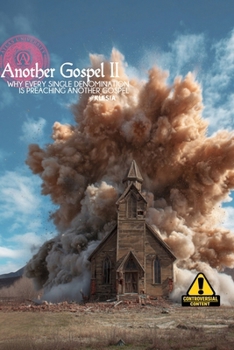
Another Gospel II: Why Every Single Denomination is Preaching Another Gospel

Another Gospel II
The Narrow Way, the Broad Church, and the Cost of Taking Scripture Seriously
There comes a moment in every honest encounter with Scripture when a terrifying possibility emerges:
the text does not resemble the religion built in its name.
Not in structure.
Not in fruit.
Not in demands.
Another Gospel II is written from that moment.
This book does not begin with theology, argument, or reform proposals. It begins with a question the modern church has learned to avoid entirely:
How does contemporary Christianity compare to the Gospel of Yeshua as it is actually written?
Not as filtered through tradition.
Not as softened by culture.
Not as revised for psychological comfort.
But as it stands-severe, narrow, uncompromising, and utterly uninterested in preserving the self.
Drawing directly from the words of Yeshua and the witness of the New Testament, Another Gospel II undertakes a sober examination of the modern Christian landscape and arrives at a conclusion few are prepared to face: much of what is preached today is not a variation of the Gospel, but something else entirely-a parallel religion that uses biblical language while quietly removing its central demand.
The Gospel, as Scripture presents it, is not a message of self-improvement, emotional healing, or cultural compatibility. It is a sentence of death upon the self. It does not stabilize identity; it dissolves it. It does not integrate into the world; it calls the believer out of it. It does not offer belonging without cost; it demands surrender without negotiation.
This book traces how that Gospel was gradually revised.
Without open rebellion or doctrinal denial, the church learned to soften the narrow way, domesticate the cross, psychologize repentance, replace obedience with belonging, exchange transformation for affirmation, and reframe salvation as comfort rather than conversion. The result is a Christianity that feels compassionate, accessible, and emotionally supportive-yet produces very few people who have actually died to the world.
Another Gospel II examines this revision across the most volatile and revealing arenas of modern faith:
the replacement of repentance with therapeutic language
the collapse of the cruciform life into metaphor
the broadening of the narrow way into institutional survivability
the transformation of conversion into emotional reassurance
the substitution of holiness with community cohesion
the psychologizing of the cross into a coping mechanism
the war on the body as temple
the redefinition of sexuality, marriage, and covenant
the loss of obedience as the visible mark of discipleship
Throughout, the book refuses caricature and avoids hatred. It does not attack individuals, nor does it deny dignity, sincerity, or human complexity. Its claim is more precise and more unsettling: the Gospel cannot be rewritten without ceasing to be the Gospel. Compassion cannot replace obedience. Inclusion cannot replace surrender. Affirmation cannot replace crucifixion.
The offense of this book is not that it is harsh.
It is that it is literal.
It takes Yeshua at His word.
Another Gospel II is written for readers who have felt the quiet dissonance between Scripture and church life but could not name it; for those who have sensed that modern Christianity asks very little while promising very much; for believers who love Yahweh yet feel spiritually untouched; for those willing to risk isolation, misunderstanding, and loss in order to obey the text rather than preserve belonging.
This book offers no refuge in institutions.
It offers no middle ground.
It offers no safe synthesis between the Kingdom and the world.
Customer Reviews
ThriftBooks ® and the ThriftBooks ® logo are registered trademarks of Thrift Books Global, LLC
