


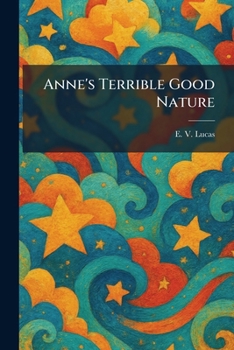
Anne's Terrible Good Nature

Select Format
Select Condition 
Book Overview
"Anne's Terrible Good Nature" is a charming collection of short stories by the celebrated British author E. V. Lucas, offering a delightful glimpse into the world of early twentieth-century childhood. The title story follows Anne, a young girl whose earnest desire to be helpful and kind often leads to unexpected and humorous complications, exploring the nuances of good intentions and their social consequences.
Beyond the adventures of Anne, the volume contains a variety of tales that capture the imagination and moral landscape of the era. From the whimsical to the poignant, Lucas employs his signature wit and keen observational skills to depict the everyday lives, play, and dilemmas of children. Whether navigating family dynamics or encountering eccentric characters, the protagonists in these stories are rendered with a warmth and sincerity that has made the work a staple of classic juvenile literature.
This collection serves as a testament to Lucas's ability to treat the concerns of youth with both seriousness and lightheartedness. Readers interested in the history of children's fiction and the social mores of the Edwardian period will find "Anne's Terrible Good Nature" to be a captivating and insightful read, filled with timeless observations on character and the simple joys of a bygone age.
This work has been selected by scholars as being culturally important, and is part of the knowledge base of civilization as we know it. This work was reproduced from the original artifact, and remains as true to the original work as possible. Therefore, you may see the original copyright references, library stamps (as most of these works have been housed in our most important libraries around the world), and other notations in the work.
This work is in the public domain in the United States of America, and possibly other nations. Within the United States, you may freely copy and distribute this work, as no entity (individual or corporate) has a copyright on the body of the work.
As a reproduction of a historical artifact, this work may contain missing or blurred pages, poor pictures, errant marks, etc. Scholars believe, and we concur, that this work is important enough to be preserved, reproduced, and made generally available to the public. We appreciate your support of the preservation process, and thank you for being an important part of keeping this knowledge alive and relevant.
Customer Reviews
ThriftBooks ® and the ThriftBooks ® logo are registered trademarks of Thrift Books Global, LLC
