


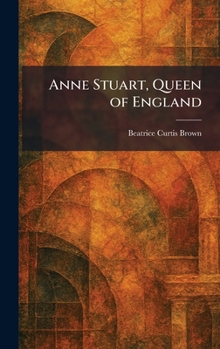
Anne Stuart, Queen of England

"Anne Stuart, Queen of England" is a compelling biographical exploration of one of Britain's most pivotal yet frequently misunderstood monarchs. Written by Beatrice Curtis Brown, this work provides an in-depth look at the life of the last Stuart sovereign, whose reign saw the formal union of England and Scotland and the rise of Great Britain as a major European power.
The narrative traces Anne's journey from her troubled youth and the political upheavals of the Glorious Revolution to her eventual ascension to the throne. Brown examines the personal and political challenges Anne faced, including her failing health, her complex relationships with influential figures like Sarah Churchill, and the intense factionalism between Whigs and Tories. Through a meticulous examination of her character and the era, the book highlights the Queen's steadfast commitment to her duty and the Church of England during a period of significant social and political transformation.
This scholarly yet accessible biography serves as an essential resource for those interested in the House of Stuart, 18th-century British history, and the intricacies of royal court life. "Anne Stuart, Queen of England" captures the essence of a woman who navigated the burdens of the crown with resilience, shaping the future of a nation.
This work has been selected by scholars as being culturally important, and is part of the knowledge base of civilization as we know it. This work was reproduced from the original artifact, and remains as true to the original work as possible. Therefore, you may see the original copyright references, library stamps (as most of these works have been housed in our most important libraries around the world), and other notations in the work.
This work is in the public domain in the United States of America, and possibly other nations. Within the United States, you may freely copy and distribute this work, as no entity (individual or corporate) has a copyright on the body of the work.
As a reproduction of a historical artifact, this work may contain missing or blurred pages, poor pictures, errant marks, etc. Scholars believe, and we concur, that this work is important enough to be preserved, reproduced, and made generally available to the public. We appreciate your support of the preservation process, and thank you for being an important part of keeping this knowledge alive and relevant.
Customer Reviews
ThriftBooks ® and the ThriftBooks ® logo are registered trademarks of Thrift Books Global, LLC
