


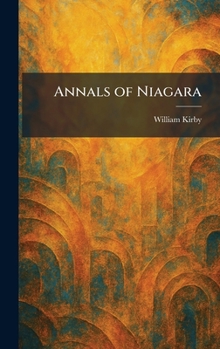
Annals of Niagara

Select Format
Select Condition 
Book Overview
"Annals of Niagara" is a comprehensive historical narrative that meticulously documents the development and heritage of the Niagara region, authored by the distinguished Canadian writer William Kirby. The work provides a detailed chronological account of one of North America's most strategic and storied frontiers, tracing its evolution from early indigenous history and European exploration through the formative years of Upper Canada.
A significant portion of the narrative is dedicated to the pivotal role the region played during the War of 1812, capturing the intensity of border conflicts and the resilience of the settlers who defended the territory. Kirby deeply explores the lives of the United Empire Loyalists, whose arrival fundamentally shaped the social and political fabric of the area. By blending archival research with a keen sense of local tradition, the author illustrates the transition of the Niagara Peninsula from a rugged wilderness into a cornerstone of the Canadian nation.
This work serves as an essential resource for understanding the foundational history of the Great Lakes region. "Annals of Niagara" offers readers an invaluable perspective on the military, political, and social forces that forged the identity of early Canada, preserving the legacy of the pioneers and events that defined the Niagara frontier.
This work has been selected by scholars as being culturally important, and is part of the knowledge base of civilization as we know it. This work was reproduced from the original artifact, and remains as true to the original work as possible. Therefore, you may see the original copyright references, library stamps (as most of these works have been housed in our most important libraries around the world), and other notations in the work.
This work is in the public domain in the United States of America, and possibly other nations. Within the United States, you may freely copy and distribute this work, as no entity (individual or corporate) has a copyright on the body of the work.
As a reproduction of a historical artifact, this work may contain missing or blurred pages, poor pictures, errant marks, etc. Scholars believe, and we concur, that this work is important enough to be preserved, reproduced, and made generally available to the public. We appreciate your support of the preservation process, and thank you for being an important part of keeping this knowledge alive and relevant.
Customer Reviews
ThriftBooks® and the ThriftBooks® logo are registered trademarks of Thrift Books Global, LLC
