


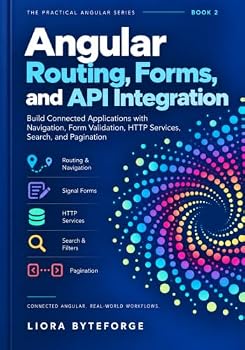
Angular Routing, Forms, and API Integration: Build Connected Applications with Navigation, Form Validation, HTTP Services, Search, and Pagination (The Practical Angular 22 Series)

Building Angular components is only the beginning. Real applications must navigate between workflows, validate user input, communicate reliably with backend services, preserve state across refreshes, and handle loading, errors, search, filtering, and pagination without becoming difficult to maintain.
Angular Routing, Forms, and API Integration takes you beyond isolated Angular components and shows you how to build a connected, production-minded Angular 22 application.
As Book 2 of The Practical Angular Series, this hands-on guide continues the PulseBoard project introduced in Book 1 and transforms it from a local application into a route-driven product backed by structured forms, typed HTTP services, URL-owned state, and server data.
You'll learn how to:
Design static, parameterized, nested, lazy-loaded, redirect, and wildcard routes
Build accessible navigation with Angular Router and component input binding
Manage route parameters, query parameters, fragments, resolvers, and navigation workflows
Build modern forms with Angular Signal Forms and schema-based validation
Handle conditional, cross-field, asynchronous, and server-backed validation
Protect unsaved work and design reliable create and edit workflows
Configure typed HttpClient services and separate API DTOs from application models
Use functional interceptors, error handling, retries, cancellation, and safe mutations
Build URL-driven search, filtering, sorting, and server-side pagination
Work with resource and httpResource for reactive data-loading workflows
Coordinate loading, empty, error, stale-data, and success states
Integrate routing, forms, HTTP services, caching, accessibility, and performance into one cohesive application
Rather than teaching Angular APIs as disconnected features, the book focuses on ownership and application boundaries-which state belongs in the URL, which belongs in a form, which belongs at the HTTP boundary, and how those pieces should work together.
By the end, you will have built a connected Angular application whose routes can be bookmarked and shared, whose forms behave predictably, whose backend integration remains typed and maintainable, and whose search and pagination survive browser refreshes.
This book is ideal for developers who already understand Angular fundamentals, standalone components, TypeScript, dependency injection, templates, and signals and are ready to build more realistic Angular applications.
Move beyond local components and start building Angular applications that behave like complete products.
Customer Reviews
ThriftBooks ® and the ThriftBooks ® logo are registered trademarks of Thrift Books Global, LLC
