


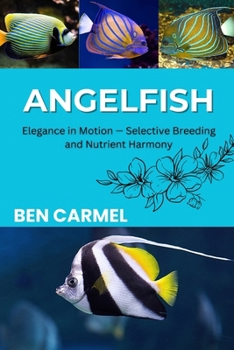
Angelfish: Elegance in Motion - Selective Breeding and Nutrient Harmony
No Customer Reviews

Dive into the vibrant world of Angelfish, a popular freshwater species celebrated for its graceful movements and striking appearance. Angelfish: Elegance in Motion provides an immersive guide with detailed illustrations, educational insights, and practical advice on diet, habitat, and care. Perfect for aquarium enthusiasts, students, and hobbyists, this book explores its breeding practices, nutrition needs, and behaviors in home and natural environments. The life cycle of the angelfish is a finely tuned biological progression, shaped by seasonal flooding, predation pressure, nutrient availability, and parental care strategies. Unlike many broadcast-spawning fish that rely on sheer numbers for survival, angelfish invest heavily in structured development and behavioral learning, especially during early life stages. Each phase-fry, juvenile, and adult-represents not merely a change in size, but a shift in physiology, behavior, and ecological role. Egg Stage: The Transitional Beginning
Before the fry stage begins, angelfish embryos develop within adhesive eggs deposited on vertical surfaces such as submerged leaves, roots, or smooth stones. This placement is evolutionarily significant:
Vertical surfaces reduce sediment accumulation
Water flow improves oxygen diffusion
Eggs remain within defensible territory
Eggs are fertilized externally and guarded continuously by both parents. During incubation:
Embryos rely on yolk reserves
Temperature influences development speed
Oxygen availability directly affects survival
This parental investment drastically increases survival odds compared to unattended eggs in open water. Fry Stage: Vulnerability and Rapid Adaptation
Once hatched, angelfish fry enter a stage defined by extreme vulnerability and accelerated learning.
Physiological Characteristics of Fry
Transparent or lightly pigmented bodies
Limited swimming capability
Underdeveloped digestive systems
High metabolic demand
Initially, fry remain attached to the spawning surface, absorbing their yolk sac. During this time, parents may relocate fry repeatedly, a behavior that reduces predation risk and improves oxygen exposure. Transition to Free-Swimming Fry
After yolk absorption, fry become free-swimming, marking the first true interaction with their environment. At this stage:
Feeding begins externally
Sensory systems rapidly mature
Survival depends on food density and water stability
In natural flooded forests, fry feed on:
Microzooplankton
Infusoria
Newly hatched aquatic invertebrates
Parental presence remains critical. Adults actively herd fry, maintain group cohesion, and deter predators through intimidation rather than direct attack.
Before the fry stage begins, angelfish embryos develop within adhesive eggs deposited on vertical surfaces such as submerged leaves, roots, or smooth stones. This placement is evolutionarily significant:
Vertical surfaces reduce sediment accumulation
Water flow improves oxygen diffusion
Eggs remain within defensible territory
Eggs are fertilized externally and guarded continuously by both parents. During incubation:
Embryos rely on yolk reserves
Temperature influences development speed
Oxygen availability directly affects survival
This parental investment drastically increases survival odds compared to unattended eggs in open water. Fry Stage: Vulnerability and Rapid Adaptation
Once hatched, angelfish fry enter a stage defined by extreme vulnerability and accelerated learning.
Physiological Characteristics of Fry
Transparent or lightly pigmented bodies
Limited swimming capability
Underdeveloped digestive systems
High metabolic demand
Initially, fry remain attached to the spawning surface, absorbing their yolk sac. During this time, parents may relocate fry repeatedly, a behavior that reduces predation risk and improves oxygen exposure. Transition to Free-Swimming Fry
After yolk absorption, fry become free-swimming, marking the first true interaction with their environment. At this stage:
Feeding begins externally
Sensory systems rapidly mature
Survival depends on food density and water stability
In natural flooded forests, fry feed on:
Microzooplankton
Infusoria
Newly hatched aquatic invertebrates
Parental presence remains critical. Adults actively herd fry, maintain group cohesion, and deter predators through intimidation rather than direct attack.
Format:Paperback
Language:English
ISBN:B0GCXNR6ZM
ISBN13:9798241397539
Release Date:December 2025
Publisher:Independently Published
Length:202 Pages
Weight:0.61 lbs.
Dimensions:0.4" x 6.0" x 9.0"
Customer Reviews
0 rating
Copyright © 2026 Thriftbooks.com Terms of Use
| Privacy Policy | Do Not
Sell/Share My Personal Information | Cookie Policy | Cookie Preferences | Accessibility Statement
ThriftBooks® and the ThriftBooks® logo are registered trademarks of Thrift Books Global, LLC
ThriftBooks® and the ThriftBooks® logo are registered trademarks of Thrift Books Global, LLC
