


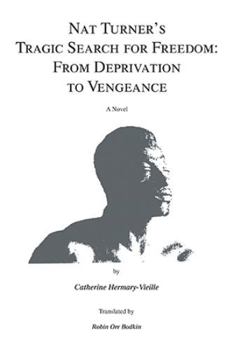
Nat Turner's Tragic Search for Freedom: From Deprivation to Vengeance

Nat Turner's Tragic Search for Freedom is a narrative of the events that led up to this rebellion as well as drove it to its bloody conclusion. If it were but a question of its known facts, which are few and far between, one might feel content with a quick determination of its import. After behavior beyond the pale, a protagonist, whether as an actual historical figure or as a fictionalized representation, receives his just due. That is, in the eyes of the law a slave rebels against his "masters" by taking their lives or encouraging others to do so. Subsequently, he is arrested, tried, and sentenced to a fate as equally horrifying as the one visited upon his victims. Catherine Hermary-Vieille, however, perceptively anchors the origin of this story elsewhere. From beginning to end she paints it with Africa in mind as well as the inescapable influence that a mother and her beliefs can bring to bear on her child. "As long as blood coursed through her Nat's mother] veins, no one would ever convince her that a black person's desire to be free was wrong or unlawful. What she did know for sure, however, was the indisputable criminality of forcing another human being into the bonds of slavery. She could never break those bonds by herself, but Nat... would find a way to do it." Thus, Hermary-Vieille invites the reader to focus not so much on the Nat Turner dossier as on the larger meaning of his life and its message. In this light his story is both a literal and figurative search for freedom, a search that tragically consumes his life as it feeds his spirit.
Customer Reviews
ThriftBooks® and the ThriftBooks® logo are registered trademarks of Thrift Books Global, LLC
