


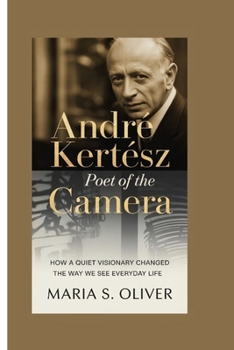
André Kertész: Poet of the Camera: How a Quiet Visionary Changed the Way We See Everyday Life

Andr Kert sz, one of the most quietly transformative figures in twentieth-century photography, redefined the way we see the world through his lens. Born in Hungary in 1894, Kert sz's life and work spanned continents, artistic movements, and decades of profound change, yet his vision remained remarkably consistent: to reveal the poetry, humor, and emotion inherent in everyday life. Unlike many of his contemporaries, Kert sz did not seek fame or sensationalism; instead, he devoted himself to a careful, deeply empathetic observation of the world, capturing fleeting moments and ordinary objects with a sensitivity and precision that elevated them to extraordinary art. Andr Kert sz: Poet of the Camera offers a comprehensive portrait of this visionary, exploring his personal journey, artistic philosophy, and enduring influence on photography and visual culture.
From his early years in Budapest, Kert sz demonstrated an extraordinary awareness of form, light, and rhythm. Walking the streets, rooftops, and markets of his native city, he learned to see the interplay between geometry and gesture, shadow and reflection, stillness and motion. These formative experiences laid the foundation for a lifetime of innovative photography, teaching him that even the most mundane scene could contain profound visual and emotional resonance. His Hungarian beginnings reveal a young man whose curiosity, discipline, and imaginative eye set the stage for an extraordinary career that would span Europe and America.
Kert sz's Paris years, during the 1920s and 1930s, represent a period of formal experimentation and artistic maturation. Immersed in the city's rich cultural environment, he explored perspective, abstraction, and distortion while maintaining his signature attention to the lyrical and humanist qualities of his subjects. From rooftops to caf s, from dancers to everyday passersby, Kert sz captured moments that were simultaneously precise, spontaneous, and poetic. His work in Paris demonstrates a mastery of composition, a sensitivity to light, and a subtle emotional intelligence that distinguishes him from his peers, influencing contemporaries such as Henri Cartier-Bresson, Brassa , and Robert Capa.
The move to New York brought new challenges and opportunities, as Kert sz adapted his vision to the energy, scale, and diversity of the city. Urban streets, parks, and domestic interiors became his subjects, and he continued to refine his approach to composition, mood, and timing. Even amid professional and personal challenges, including the loss of his beloved wife Elizabeth, Kert sz produced work of quiet beauty and remarkable coherence. His Polaroids, still lifes, and domestic studies from this period reveal an artist deeply engaged with the interplay of light, space, and memory, demonstrating that his vision could evolve without compromising its essential poetic and humanist qualities.
Kert sz's enduring influence lies not only in his photographs but also in the principles that guided them: careful observation, respect for his subjects, and the ability to find the extraordinary in the ordinary. His work bridges European modernism and American urbanism, blending formal experimentation with emotional depth. Exhibitions, retrospectives, and scholarly studies have ensured that his images remain central to the understanding of modern photography, while his influence continues to inspire contemporary photographers, filmmakers, and visual artists across multiple disciplines.
Through Kert sz's life and work, readers are invited to reflect on the possibilities of seeing the world differently, appreciating nuance, rhythm, and beauty in daily life. His career exemplifies the transformative power of patience, sensitivity, and vision, showing that photography can serve as both art and documentation, a means of emotional expression, and a method of shaping perception. Andr Kert sz: Poet of the Camera.
Customer Reviews
ThriftBooks® and the ThriftBooks® logo are registered trademarks of Thrift Books Global, LLC
