


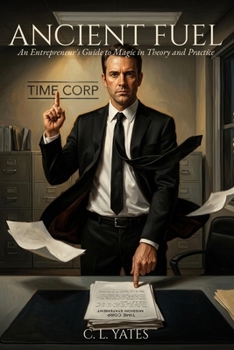
Ancient Fuel: An Entrepreneur's Guide to Magic in Theory and Practice

A business has a name on the door, and the name receives whatever people feel about it.
Customers, competitors, regulators, staff, and strangers send attention at that name every day with a feeling attached, and the founder lives with what arrives. Ancient Fuel is about what arrives, how it travels, what it lands on, and what can be done with it.
The question that produced the book is whether hostility addressed to a name can be turned into fuel for the work the name stands for. The Western esoteric tradition has held the answer for two thousand years: yes, with conditions. To turn a charge you have to know what a charge is, how it is sent, what it is addressed to, and what the receiving does. Agrippa wrote it down in 1533. Plotinus wrote it down in the third century. The Greek magical papyri contain business spells for a shop. The Roman merchant sprinkled his goods at Mercury's spring every May and asked for profit. None of it is in the business books.
Part One gives the theory: how attention with emotion attached becomes force, how the name is its address, how the receiver's structure decides what the force does, what happens when a group is the receiver, and what the documented business record shows. Nike and Ratners. Goya and Bud Light. Amazon and Theranos. Same hostile attention, opposite results, and the reason why.
Part Two gives the foundations: the business as a founded body, the mission statement as its constitution, the logo as its consecrated address, the presiding planetary current, the founding election, and the founder as the one who does the work alone.
Part Three gives forty-two complete operations in the order a business lives them: capital and cash flow, staff, customers, government and institutions, competitors and critics, working constructs built for a task and a term, maintenance, and the clean ending of a venture. Each operation is given with its timing, construction, private act, failure modes, and closure, then again for the founder who holds the address personally, then as a worked example.
Part Four is the reference: a problem index from symptom to operation, the correspondence table built for commerce, the planetary hours, a worked founding election computed for a real date, the twenty-eight mansions of the Moon with their images, the images of the planets, the seven planetary squares, a glossary, and a full index.
From the author of Planetary Ceremonial Magic, Elemental Ceremonial Magic, and Modern Theurgy.
Customer Reviews
ThriftBooks ® and the ThriftBooks ® logo are registered trademarks of Thrift Books Global, LLC
