


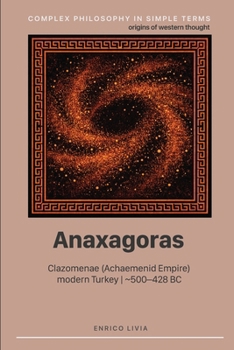
Anaxagoras
No Customer Reviews

Philosophy demands attention. This book invites you to read calmly and offers a clear, structured path -without losing rigor or falling into oversimplification.
Anaxagoras brought to Athens a way of thinking that sought natural causes even in the heavens, where many still saw divine signs. In his view, the sun was incandescent matter, the moon a body similar to the earth, and eclipses natural phenomena produced by the interposition of heavenly bodies.
In a city as sophisticated as Athens, saying that the sun was an incandescent stone would hardly have been enough, by itself, to destroy a man. But when someone stood close to power and became politically vulnerable, an inconvenient idea could become an accusation -and even the search for truth could become dangerous.
In this book you'll find: his key ideas explained in their historical contextNous (intellect as the ordering cause)everything in everything (mixture and predominance)a look at their impact on later thoughthis reflections on the divine, truth, good and evil, and deatha final section of critiques and open questions to deepen the explorationa guide to sources and recommended readings
This volume is part of the series Complex Philosophy in Simple Terms. Each book can be read on its own, but it also connects with the others within a larger journey that traces Western philosophy from its beginnings to the modern search for meaning.
Anaxagoras brought to Athens a way of thinking that sought natural causes even in the heavens, where many still saw divine signs. In his view, the sun was incandescent matter, the moon a body similar to the earth, and eclipses natural phenomena produced by the interposition of heavenly bodies.
In a city as sophisticated as Athens, saying that the sun was an incandescent stone would hardly have been enough, by itself, to destroy a man. But when someone stood close to power and became politically vulnerable, an inconvenient idea could become an accusation -and even the search for truth could become dangerous.
In this book you'll find: his key ideas explained in their historical contextNous (intellect as the ordering cause)everything in everything (mixture and predominance)a look at their impact on later thoughthis reflections on the divine, truth, good and evil, and deatha final section of critiques and open questions to deepen the explorationa guide to sources and recommended readings
This volume is part of the series Complex Philosophy in Simple Terms. Each book can be read on its own, but it also connects with the others within a larger journey that traces Western philosophy from its beginnings to the modern search for meaning.
Format:Paperback
Language:English
ISBN:B0H7VS5RTY
ISBN13:9798185958575
Release Date:July 2026
Publisher:Independently Published
Length:54 Pages
Weight:0.17 lbs.
Dimensions:0.1" x 6.0" x 9.0"
Related Subjects
PhilosophyCustomer Reviews
0 rating
Copyright © 2026 Thriftbooks.com
Terms of Use | Privacy Policy | Do Not Sell/Share My Personal Information | Cookie Notice | Cookie Preferences | Accessibility Statement
ThriftBooks ® and the ThriftBooks ® logo are registered trademarks of Thrift Books Global, LLC
ThriftBooks ® and the ThriftBooks ® logo are registered trademarks of Thrift Books Global, LLC
