


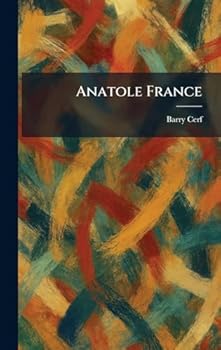
Anatole France

"Anatole France" by Barry Cerf provides an in-depth critical study of one of the preeminent voices in French literature. As a Nobel Prize winner and a master of prose, France left an indelible mark on the literary landscape, and this work systematically evaluates his vast artistic output. Cerf examines France's various roles as a poet, novelist, and essayist, exploring the philosophical undercurrents and stylistic mastery that defined his career.
The book investigates the evolution of France's thought, from his early classical influences to the biting satire and skepticism found in his later masterpieces. By analyzing themes of humanism, irony, and social critique, Cerf offers readers a window into the intellectual climate of the late nineteenth and early twentieth centuries. This volume serves as both a biographical overview and a rigorous literary appraisal, highlighting France's significance as a cultural icon and a defender of reason. It is an invaluable resource for anyone seeking to understand the legacy of a writer who epitomized the elegance and complexity of the French literary tradition.
This work has been selected by scholars as being culturally important, and is part of the knowledge base of civilization as we know it. This work was reproduced from the original artifact, and remains as true to the original work as possible. Therefore, you may see the original copyright references, library stamps (as most of these works have been housed in our most important libraries around the world), and other notations in the work.
This work is in the public domain in the United States of America, and possibly other nations. Within the United States, you may freely copy and distribute this work, as no entity (individual or corporate) has a copyright on the body of the work.
As a reproduction of a historical artifact, this work may contain missing or blurred pages, poor pictures, errant marks, etc. Scholars believe, and we concur, that this work is important enough to be preserved, reproduced, and made generally available to the public. We appreciate your support of the preservation process, and thank you for being an important part of keeping this knowledge alive and relevant.
Customer Reviews
ThriftBooks® and the ThriftBooks® logo are registered trademarks of Thrift Books Global, LLC
