


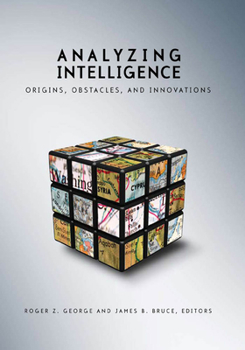
Analyzing Intelligence: Origins, Obstacles, and Innovations


Select Format
Select Condition 
Book Overview
Drawing on the individual and collective experience of recognized intelligence experts and scholars in the field, Analyzing Intelligence provides the first comprehensive assessment of the state of... This description may be from another edition of this product.
Format:Paperback
Language:English
ISBN:1589012011
ISBN13:9781589012011
Release Date:April 2008
Publisher:Georgetown University Press
Length:288 Pages
Weight:1.44 lbs.
Dimensions:10.0" x 1.0" x 7.0"
Grade Range:Postsecondary and higher
Customer Reviews
5 ratings
Finished Intelligence
Published by Thriftbooks.com User , 16 years ago
The `intelligence' that this book refers to is what was once known as `finished intelligence' that is intelligence designed primarily to inform the President and members of the National Security Council (NSC). It directly supports the executive level formation of national policies relating to national security and foreign affairs. In theory this policy level intelligence is produced by intelligence analysts who combine subject matter knowledge with research and analytic techniques to transform all source information into the most accurate intelligence possible. As the various contributors to this book sometimes make clear this level of intelligence is a matter of probabilities not absolutes. Because finished intelligence is so closely associated with policy formation, the book includes a variety of thoughts on the relationship between the intelligence analyst and policy makers and national strategists. Since this level of intelligence often requires the analyst to make subjective judgments based on often inconclusive evidence, the book also has useful discussions of the dangers of politicization to sound intelligence products. These two threads appear to run throughout the book and are illustrated in concrete examples that highlight the thin line between informing policy making and politicization. The first half of this book deals with what are by necessity fairly high level issues that impact the analytic processes, but not necessarily the intelligence analysts except indirectly. The second half of the book is a general, but serious look at the process of analysis and the analysts who execute that process. On this subject Jack Davis and Carmen Medina have some very interesting things to say about the analytic process (and those who execute that process). Also one of the book's editors, James Bruce, makes an observation on the relationship between epistemology and intelligence production. This relationship should be obvious, but until someone like Bruce makes it, the relationship is often ignored. A good treatment of an important subject, but for details on what a finished intelligence analyst actually does for a living read "Lost Promise" by John Gentry.
Exceptional read
Published by Thriftbooks.com User , 16 years ago
This book was an exceptional read. Each chapter, written by a leader within the community, touches on a critical topic in the field of intelligence analysis. I highly recommend this book for anyone who is serious about broadening their understanding of analysis and ways to improve the discipline.
Of, By, and For USA Status Quo Bubbas--Essential but Very Partial
Published by Thriftbooks.com User , 16 years ago
This is a very fine book, not least because of its inclusion of Jack Davis (search for as well as Carmen Medina (see her presentation to global audience via oss.net/LIBRARY), but in its essentials this is a book of, by, and for the status quo ante bubbas--the American bubbas, I might add. If you are an analyst or a trainer of analysts or a manager of analysts, this is assuredly essential reading, but it perpetuates my long-standing concerns about American intelligence: 1) Lack of a strategic analytic model (see Earth Intelligence Network) 2) Lack of deep historical and multi-cultural appreciation 3) Lack of a deep understanding and necessary voice on the complete inadequacy of collection sources, the zero presence of processing and lack of desktop analytic tools, and the need for ABSOLUTE devotion to the truth, not--as is still the case, "within the reasonable bounds of dishonesty" aka "slam dunk" 4) Lack of integrity in so many ways, not least of which is the analytic abject acceptance of the false premise that the best intelligence is top secret/sensitive compartmented information--see the online CounterPunch piece on "Intelligence for the President--AND Everyone Else." Below are ten books I recommend as substantive complements to this book: The Landscape of History: How Historians Map the Past Lost History: Contras, Cocaine, the Press & 'Project Truth' Fog Facts : Searching for Truth in the Land of Spin (Nation Books) Lost Promise The Age of Missing Information (Plume) Informing Statecraft Bureaucratic Politics And Foreign Policy A More Secure World: Our Shared Responsibility--Report of the Secretary-General's High-level Panel on Threats, Challenges and Change Legacy of Ashes: The History of the CIA The Shadow Factory: The Ultra-Secret NSA from 9/11 to the Eavesdropping on America
An impressively articulate and scholarly body of work
Published by Thriftbooks.com User , 17 years ago
Expertly compiled and deftly co-edited by Roger Z. George (a career analyst serving in the CIA, State Department, and Defense Department) and James B. Bruce (a retired career CIA intelligence analyst who served with the National Intelligence council, in the Directorates of Intelligence and Operations, as well as other intelligence community organizations), "Analyzing Intelligence: Origins, Obstacles, And Innovations" is a compilation of informed and informative essays and articles on the subject of intelligence analysis providing academia, professionals, and non-specialist general readers with an interest in the subject with a comprehensive overview of the issues, tools, and resources that American intelligence services and departments have with respect to obtaining and understanding the information that they collect. Beginning with a basic introduction to intelligence analysis by James B. Bruce and Roger Z. George, the knowledgeable contributors cover analytic tradition and history, the role of the analyst, the challenges endemic to intelligence analysis, common problems and concerns associated with intelligence analysis, as well as trends and changes within the field of intelligence analysis. An impressively articulate and scholarly body of work, "Analyzing Intelligence" is especially recommended for academic, governmental, and community library reference collections, and the supplemental reading lists of students, journalists, and interested general readers with an interest in the subject.
A "must have" for the intelligence analyst's bookshelf
Published by Thriftbooks.com User , 17 years ago
This is not an Analysis 101 book. It is a serious, insightful look at the important aspects of intelligence analysis as it is practiced and should be practiced. The contributors include the elite of the intelligence analysis business - Heuer, Kerr, Davis, Gannon, and Lowenthal, among others. They are people who speak with authority based on their expertise and experience in all aspects of intelligence. The contributors had the agenda of elucidating for readers the heart and soul of intelligence analysis, and they succeeded. Several chapters by themselves would be worth the price of the book: John McLaughlin's chapter on dealing with the policymaker customer; Dick Kerr's chapter on the CIA analysis history; or Jack Davis' chapter on analytic pitfalls, among others. The book reflects the political and military analytic background of the contributors. Consequently, it gives less attention to the economic and S & T/weapons systems analysis perspective - not a serious flaw, since these are rather specialized fields of analysis having a distinct customer set. The only chapter that could be substantially improved is the one of military intelligence analysis, which spends too much space lamenting the lack of respect accorded to military intelligence analysis and insufficient space in discussing what it really is all about. Overall, this book is a major contribution to the intelligence literature and should be on every analyst's bookshelf.
Copyright © 2026 Thriftbooks.com Terms of Use
| Privacy Policy | Do Not
Sell/Share My Personal Information | Cookie Policy | Cookie Preferences | Accessibility Statement
ThriftBooks® and the ThriftBooks® logo are registered trademarks of Thrift Books Global, LLC
ThriftBooks® and the ThriftBooks® logo are registered trademarks of Thrift Books Global, LLC
