


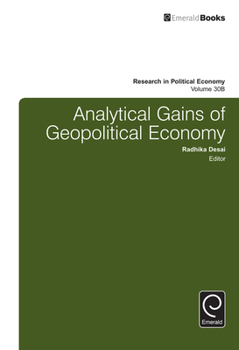
Analytical Gains of Geopolitical Economy
No Customer Reviews

This work advances geopolitical economy as a new approach to understanding the evolution of the capitalist world order and its 21st century form of multipolarity. Neither can be explained by recently dominant approaches such as U.S. hegemony or globalization: they treat the world economy as a seamless whole in which either no state matters or only one does. Today's BRICs and emerging economies are only the latest instances of state-led or combined development. Such development has a long history of repeatedly challenging the unevenness of capitalism and the international division of labour it created. It is this dialectic of uneven and combined development, not markets or imperialism, which has spread productive capacity around the world. It also ensured that the hegemony of the UK would end and attempts to create that of the US would peter out into multipolarity. Part two of this book paves the way, advancing Geopolitical Economy as a new approach to the study of international relations and international political economy. Following on from the theoretical limitations exposed in Part I, in this volume the analytical limitations are explored.
Format:Hardcover
Language:English
ISBN:178560337X
ISBN13:9781785603372
Release Date:January 2016
Publisher:Emerald Group Publishing
Length:304 Pages
Weight:1.25 lbs.
Dimensions:1.1" x 6.1" x 9.1"
Customer Reviews
0 rating
Copyright © 2026 Thriftbooks.com Terms of Use
| Privacy Policy | Do Not
Sell/Share My Personal Information | Cookie Policy | Cookie Preferences | Accessibility Statement
ThriftBooks® and the ThriftBooks® logo are registered trademarks of Thrift Books Global, LLC
ThriftBooks® and the ThriftBooks® logo are registered trademarks of Thrift Books Global, LLC
