


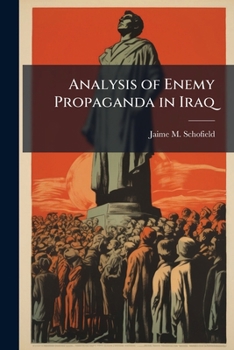
Analysis of Enemy Propaganda in Iraq

The US should stop blaming the American mainstream media for the failure of Iraqi citizens to more strongly support the country's efforts in Iraq. The key to making US efforts more effective is to connect with the Iraqi people who are not watching the American networks. In order to compete with the enemy for the hearts and minds of the Iraqi people, the US must realize that first, the target audience identifies much closer culturally with the enemy than they do with Americans. Second, the Iraqi people by nature are skeptical of government promoted propaganda. Considering these challenges, it becomes increasingly critical that the US avoid incidents that undermine US credibility while simultaneously strengthening the enemy's. The United States' vulnerability to further credibility gaps is so critical that it may want to consider adopting more cooperative policies that are less likely to further escalate Iraqi distrust of its efforts. Although this cooperative policy may not be the optimum course of action for purely fighting terrorists in the short term, it would increase the chances of success in the Iraqi conflict. Success in that fight would ultimately strengthen US terrorist efforts in the long term. The internet is here to stay and that means in future conflicts, the enemy will always have a voice. Rather than wasting effort trying to silence that voice, the US will reap bigger dividends by fighting the enemy's propaganda content rather than the channel that it is transmitted by-- attack the message, not necessarily the messenger.
This work has been selected by scholars as being culturally important, and is part of the knowledge base of civilization as we know it. This work was reproduced from the original artifact, and remains as true to the original work as possible. Therefore, you will see the original copyright references, library stamps (as most of these works have been housed in our most important libraries around the world), and other notations in the work.
This work is in the public domain in the United States of America, and possibly other nations. Within the United States, you may freely copy and distribute this work, as no entity (individual or corporate) has a copyright on the body of the work.
As a reproduction of a historical artifact, this work may contain missing or blurred pages, poor pictures, errant marks, etc. Scholars believe, and we concur, that this work is important enough to be preserved, reproduced, and made generally available to the public. We appreciate your support of the preservation process, and thank you for being an important part of keeping this knowledge alive and relevant.
Related Subjects
Education Education & Reference History Political Science Politics & Social SciencesCustomer Reviews
ThriftBooks® and the ThriftBooks® logo are registered trademarks of Thrift Books Global, LLC
