


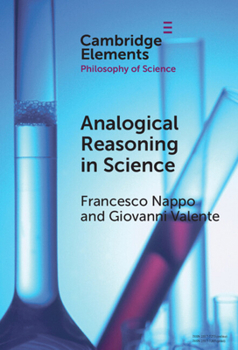
Analogical Reasoning in Science
No Customer Reviews

When faced with a difficult problem or limited information about a novel domain, how do scientists advance their research? As historians of science have widely noted, one strategy common to the natural and the social sciences is to make use of analogy. Formulating hypotheses about an unknown system construed by analogy with what is observed in a more familiar system has repeatedly proven to be a source of discoveries. But what makes analogy such a useful tool for scientific inquiry? Although early reflections trace back to Aristotle, the question of the exact role of analogy in science remains an outstanding one in contemporary philosophy of science. This Element aims to clarify the main epistemological questions at stake and why seemingly obvious answers to them do not survive scrutiny. We provide an overview of the current debate and summarize insights from relevant case studies in the natural and social sciences.
Format:Hardcover
Language:English
ISBN:1009526464
ISBN13:9781009526463
Release Date:July 2026
Publisher:Cambridge University Press
Length:80 Pages
Weight:0.62 lbs.
Dimensions:0.3" x 6.0" x 9.0"
Customer Reviews
0 rating
Copyright © 2026 Thriftbooks.com
Terms of Use | Privacy Policy | Do Not Sell/Share My Personal Information | Cookie Notice | Cookie Preferences | Accessibility Statement
ThriftBooks ® and the ThriftBooks ® logo are registered trademarks of Thrift Books Global, LLC
ThriftBooks ® and the ThriftBooks ® logo are registered trademarks of Thrift Books Global, LLC
