


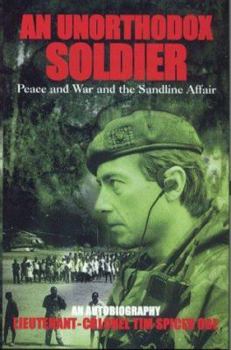
An Unorthodox Soldier

Select Format
Select Condition 
Book Overview
In this fast-moving account of his life, Tim Spicer describes all the events surrounding the catastrophe in Papua New Guinea, when he was captured at gunpoint and held in captivity - and came away... This description may be from another edition of this product.
Format:Paperback
Language:English
ISBN:1840183497
ISBN13:9781840183498
Release Date:October 1999
Publisher:Mainstream Publishing
Length:256 Pages
Weight:0.65 lbs.
Dimensions:7.7" x 0.8" x 5.1"
Customer Reviews
4 ratings
Soldiering as an occupation, war as an industry.
Published by Thriftbooks.com User , 17 years ago
This is a brave book, free of the bitter blood and guts filling current works in the category. There's a lot more serotonin than testosterone here. The work isn't about bravery under fire; it's about the ideas a very professional man has about his occupation, Soldiering. And his industry, - War. In our present international state Spicer's Peace Making makes more sense than the U.N.'s Peace Keeping. In a world where our leaders run around like rock stars continually checking their popularity poles, Tim Spicer takes a hard look at the best way to save lives, civilian and military. He lays out how war actually works covering the necessary facts and not drowning the reader in details. There's no harping on the cold hard facts of being a soldier; he relates the conditions as if it's of no more importance than a weather report. While the world leaders are busy ranting and consoling, the man with the gun seems to be the only one thinking. Spicer's case for P.M.C's is well organized and placed in relevant areas within the story of his experiences as a soldier. It brings up important questions that eventually must be dealt with. The logic is irrefutable, men are a P.M.C.'s assets; companies don't waste assets the way governments have been known waste soldiers. The cold logic of his arguments is like the truths he reveals, a little hard to take at times. Far from being the unfeeling hard [nosed] commander, his anguish bleeds through when he tells the tale of how badly two of his men were treated in Ireland and his frustrated anger is clear when dealing with several government double crosses. He seems to find these more insulting than frightening because they are so hopelessly flawed. It's almost as if he were saying, "And these are the guys running things?" Throughout it all there is humor, passion and suspense and not all questions are answered. I find myself still wondering where the knife, compass and money was? Spicer doesn't tell us or the enemy everything. All said, though this might not be considered a woman's book, I found Spicer's work strangely comforting, even hopeful.
excellent view of the future of military needs
Published by Thriftbooks.com User , 18 years ago
The autobiography is interesting but what I found particularly thought provoking is the discussion of what the future holds for government armies and the new world of terrorism and insurgencies. What Col. Spicer predicted 7 years ago as a need for private security forces to be used by legitimate governments has come to pass. I would recommend this book to anyone who wishes to understand the complicated future of the modern military.
Soldier of Fortune.
Published by Thriftbooks.com User , 20 years ago
This an interesting book, focusing on the merits of the modern Private Military Company/Contractor (PMC) and why the common perception of such a military resource is outmoded. Ironically, it is the quality of the governments cited as arbiters of high moral standards which is repeatedly called into question: From the political expediency that branded Guardsmen Fisher and Wright as murderers, to the incredibly senseless actions by the British Foreign Office under the leadership of the now deceased Robin Cook over the Sierra Leone/Sandline affair, which almost led to the imprisonment of Lieutenant-Colonel Tim Spicer for allegedly breaching UNSCR 1132. Sandline is no more. But Lieutenant-Colonel Tim Spicer is now at the head of Aegis, the most prominent PMC operating in Iraq, where many of the services alluded to in his book are being effectively deployed in the manner he envisaged.
Soldiering as an occupation, war as an industry.
Published by Thriftbooks.com User , 24 years ago
This is a brave book, free of the bitter blood and guts filling current works in the category. There's a lot more serotonin than testosterone here. The work isn't about bravery under fire; it's about the ideas a very professional man has about his occupation, Soldiering. And his industry, - War. In our present international state Spicer's Peace Making makes more sense than the U.N.'s Peace Keeping. In a world where our leaders run around like rock stars continually checking their popularity poles, Tim Spicer takes a hard look at the best way to save lives, civilian and military. He lays out how war actually works covering the necessary facts and not drowning the reader in details. There's no harping on the cold hard facts of being a soldier; he relates the conditions as if it's of no more importance than a weather report. While the world leaders are busy ranting and consoling, the man with the gun seems to be the only one thinking. Spicer's case for P.M.C's is well organized and placed in relevant areas within the story of his experiences as a soldier. It brings up important questions that eventually must be dealt with. The logic is irrefutable, men are a P.M.C.'s assets; companies don't waste assets the way governments have been known waste soldiers. The cold logic of his arguments is like the truths he reveals, a little hard to take at times. Far from being the unfeeling hard [nosed] commander, his anguish bleeds through when he tells the tale of how badly two of his men were treated in Ireland and his frustrated anger is clear when dealing with several government double crosses. He seems to find these more insulting than frightening because they are so hopelessly flawed. It's almost as if he were saying, "And these are the guys running things?" Throughout it all there is humor, passion and suspense and not all questions are answered. I find myself still wondering where the knife, compass and money was? Spicer doesn't tell us or the enemy everything.All said, though this might not be considered a woman's book, I found Spicer's work strangely comforting, even hopeful.
Copyright © 2026 Thriftbooks.com
Terms of Use | Privacy Policy | Do Not Sell/Share My Personal Information | Cookie Policy | Cookie Preferences | Accessibility Statement
ThriftBooks ® and the ThriftBooks ® logo are registered trademarks of Thrift Books Global, LLC
ThriftBooks ® and the ThriftBooks ® logo are registered trademarks of Thrift Books Global, LLC
