


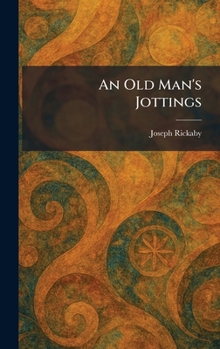
An Old Man's Jottings

"An Old Man's Jottings" is a profound collection of reflections, aphorisms, and brief essays by the noted Jesuit scholar Joseph Rickaby. Written toward the end of his long and distinguished career, this work serves as an intimate window into the mind of a thinker who spent a lifetime reconciling the demands of faith with the rigor of philosophical inquiry.
The book covers a vast array of subjects, ranging from deep questions of moral theology and ethics to the quiet observations of daily life and the nuances of spiritual devotion. Rickaby's writing is characterized by its clarity, wit, and a gentle wisdom that avoids dogmatism in favor of insightful contemplation. Each entry, though concise, invites the reader to pause and consider the deeper meaning behind seemingly simple truths and complex theological concepts alike.
Ideal for those interested in Catholic thought, philosophical ethics, or the history of Jesuit intellectualism, "An Old Man's Jottings" offers a timeless exploration of what it means to live a life dedicated to both the mind and the soul. It remains a valuable resource for readers seeking spiritual nourishment and intellectual stimulation from one of the early 20th century's most respected religious thinkers.
This work has been selected by scholars as being culturally important, and is part of the knowledge base of civilization as we know it. This work was reproduced from the original artifact, and remains as true to the original work as possible. Therefore, you may see the original copyright references, library stamps (as most of these works have been housed in our most important libraries around the world), and other notations in the work.
This work is in the public domain in the United States of America, and possibly other nations. Within the United States, you may freely copy and distribute this work, as no entity (individual or corporate) has a copyright on the body of the work.
As a reproduction of a historical artifact, this work may contain missing or blurred pages, poor pictures, errant marks, etc. Scholars believe, and we concur, that this work is important enough to be preserved, reproduced, and made generally available to the public. We appreciate your support of the preservation process, and thank you for being an important part of keeping this knowledge alive and relevant.
Customer Reviews
ThriftBooks ® and the ThriftBooks ® logo are registered trademarks of Thrift Books Global, LLC
