


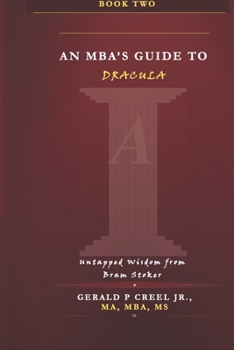
An MBA's Guide to Dracula: Untapped Wisdom from Bram Stoker

What if the most useful business book ever written wasn't a business book at all?
An MBA's Guide to Dracula is Book Two of An MBA's Guide to the Classics - a series written by a lifelong scholar of literature and history for readers who believe the great novels were never just stories. This series reclaims the classics as primary sources for understanding leadership, organizational behavior, business management, interpersonal dynamics, business strategy, and the enduring patterns of human nature that no MBA program fully captures. We are the people who always suspected these books contained more than the curriculum admitted.
The Argument Is Simple
In 1897, Bram Stoker wrote a novel about a vampire terrorizing Victorian England. He was not trying to write a business book.
He wrote one anyway.
Strip away the Gothic horror and the 19th-century superstition, and Dracula is a precise, unflinching examination of everything modern organizations still get wrong - predatory leadership, institutional capture, knowledge failure, coalition breakdown, and what genuine organizational survival actually requires.
Stoker got there first. Business theory spent the next 125 years catching up.
Eight Chapters. Eight Lessons Hidden in a Classic.
The Castle and the Due Diligence - Confirmation bias, deal velocity, and why smart people walk into catastrophic commitments with the evidence of danger in their handsDracula's Business Model - Corporate vampirism, extraction versus creation, and the predatory leadership playbook that Al Dunlap, Travis Kalanick, and Purdue Pharma ran to the letterRenfield's Bargain - Complicity, sycophancy, organizational capture, and the psychology of the person who holds the door open for the thing destroying the institutionLucy and the Unconverted Institution - Institutional drift, normalized deviance, and why the warning signals that precede every organizational collapse were visible long before the collapse arrivedThe Epistolary Organization - Knowledge management, information sharing, and what Mina Harker understood about organizational intelligence that most knowledge management frameworks still missVan Helsing's Expertise - Interdisciplinary thinking, T-shaped leadership, the generalist advantage, and why the most dangerous threats require someone who refuses to stay in their laneThe Crew of Light - Crisis coalition assembly, swift trust, role flexibility under pressure, and what genuine leadership in extremis actually looks like from the insideThe Undead Organization - Zombie institutions, sunk cost entrenchment, organizational death denial, and when creative destruction is not a threat but a mercyWho This Book Is For
This book is for the MBA who never expected a 19th-century Gothic novel to clarify what three years in a boardroom couldn't.
It is for the English major, the humanities graduate, and the avid reader of literary fiction who found themselves - perhaps reluctantly - in the world of business, and who suspected all along that the novels they loved had more to teach about human behavior than the frameworks their colleagues swore by.
And it is for anyone who has spent time inside an organization and felt that the available frameworks - however well constructed - don't quite capture what organizational life actually feels like from the inside.
They name what goes wrong. Stoker rendered it.
This book uses that rendering to make the naming more precise.
For business students, executives, leaders, humanities graduates, and anyone who ever suspected that great literature knew things the business school curriculum hadn't caught up to yet.
Forthcoming in the series: An MBA's Guide to The Picture of Dorian Gray, An MBA's Guide to Alice in Wonderland, An MBA's Guide to Jane Eyre, and more.
Customer Reviews
ThriftBooks ® and the ThriftBooks ® logo are registered trademarks of Thrift Books Global, LLC
