


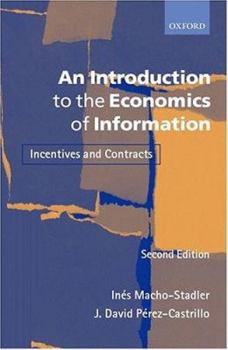
An Introduction to the Economics of Information: Incentives and Contracts


This is an advanced textbook on the theory of contracting under asymmetric information, a key part of modern microeconomic theory. It examines the characteristics of optimal contracts when one party has certain relevant knowledge that the other party does not. The various problems are presented in the same framework to allow easy comparison of the different results. The authors indicate substantial real-world applications, and exercises for students (with solutions) are provided at the end of each chapter.
Format:Paperback
Language:English
ISBN:0198774664
ISBN13:9780198774662
Release Date:February 1997
Publisher:Oxford University Press
Length:292 Pages
Weight:1.00 lbs.
Dimensions:9.1" x 0.6" x 6.1"
Customer Reviews
3 ratings
good book that suffers in translation
Published by Thriftbooks.com User , 16 years ago
I've been assigned this book (as well as Bolton and Dewatripont's Contract Theory text) for a grad-level information class. In a way I'm of two minds -- this book is for the most part a clear, well-motivated introduction to the subject, a useful accompaniment to B & P's rather dryer book. On the other hand it's an obvious translation, full of typographical errors and amusing Spanglish. I don't know, for instance, what the monotonous likelihood quotient property is, but it certainly sounds bad. All chapter exercises have answers in the back and there are just enough of them. For autodidacts (in whose company I count myself) this is immeasurably useful, an example I wish more textbooks would follow. Without the guidance of a teacher it's *hard* to pick your way through end-of-chapter problems in most books, when there are usually far too many of them and there's no way to get help when you're stuck.
Economics of Information
Published by Thriftbooks.com User , 18 years ago
Few books are concerned with this subject. Inés Macho-Stadler and David Pérez-Castrillo were able to explain in a intuitive and structural way the problems derived from asymmetric information. This book guides you along the way to understand clearly the features of this themes.
Information to the reader: this book is good
Published by Thriftbooks.com User , 25 years ago
In less than three hundred pages, the authors are able to introduce Moral Hazard, Adverse Selection and Signalling in an outstanding accessible way. Given the importance of contract theory in modern Economics, undoubtedely this is the first book to be read. Each chapter is full of examples and graphs that help to understand the mathematics underneath. The reader is supposed to know Kuhn-Tucker theorem, so any advanced undergraduate student in economics should be able to read it. The base model, presented in chapter 2, is used as a benchmark to compare wirh the results obtained from the Moral Hazard model (brilliantly presented in chapter 3), Adverse Selection (chapter 4) and Signalling (chapter 5). Each chapter has very well posed exercises, whose answers are in the end of the book. Furthermore, advanced themes are also discussed in the end of each chapter, giving to the reader a complete overview about theory of information. So, since this theme has been increasingly important in modern economics, and given that this book is very easily readable, I strongly recommend it to any person who wishes to understand theory of contracts and incetives.
Copyright © 2026 Thriftbooks.com Terms of Use
| Privacy Policy | Do Not
Sell/Share My Personal Information | Cookie Policy | Cookie Preferences | Accessibility Statement
ThriftBooks® and the ThriftBooks® logo are registered trademarks of Thrift Books Global, LLC
ThriftBooks® and the ThriftBooks® logo are registered trademarks of Thrift Books Global, LLC
