


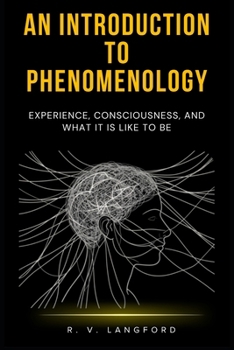
An Introduction to Phenomenology: Experience, Consciousness, and What It Is Like to Be

There is something it is like to hear music, feel grief, or see another person's face. Phenomenology is the philosophy built to describe it precisely.
Phenomenology begins from a deceptively simple observation: we are always already experiencing the world, and the structure of that experience is not nothing. The sciences describe the world from the outside, in terms of causes and mechanisms. Phenomenology describes the world as it is lived from the inside, tracing the structures that belong to experience itself. It is a philosophical discipline with its own methods, its own canon of major thinkers, and its own arguments about why attending to experience is philosophically fundamental.
This book introduces that discipline to readers with no prior training in philosophy. It covers the tradition from Franz Brentano's foundational work on intentionality through Husserl's systematic analyses, Heidegger's transformation of phenomenology into an account of human existence, Merleau-Ponty's philosophy of embodied perception, Sartre's existential phenomenology, de Beauvoir's situated and gendered extension of the tradition, and Levinas's ethical phenomenology of alterity. A final Part covers contemporary applications in psychopathology, cognitive science, social theory, architecture, and ecology. Each thinker is introduced through a philosophical problem the reader can recognise in their own experience, followed by the analysis that illuminates it.
What intentionality is and why Brentano's insight that every act of consciousness is directed at an object became the tradition's founding observationWhat Husserl's phenomenological reduction involves and what the claim that experience has a describable structure means in practiceWhy Heidegger rejected Husserl's starting point and what being-in-the-world means: that human existence is always already engaged with a world of tools, meanings, and others before any theoretical stance is possibleWhat thrownness, care, and authenticity mean in Heidegger's account, and how anxiety discloses the most fundamental features of human existenceHow Merleau-Ponty's analysis of the lived body challenged idealist and behaviourist accounts of perception, and why it remains influential in cognitive science and clinical psychologyHow de Beauvoir's analysis of gendered facticity and situated existence is a genuine philosophical achievement, not an application of someone else's frameworkWhat phenomenological psychiatry has contributed to understanding depression, schizophrenia, and anxiety by describing disturbed experience rather than treating it exclusively as biologicalHow phenomenology and cognitive science have moved toward productive dialogue, and why Zahavi, Gallagher, and Thompson argue that first-person description and neuroscience answer different questionsWhere the tradition has genuine limitations: Eurocentric assumptions, the ethical failings of specific thinkers, and questions opened without yet being fully answeredAccessible to any reader willing to think carefully, honest about what remains contested, and organised so that the philosophy always illuminates something the reader can recognise in their own experience, this is the standard introduction that students, practitioners, and intellectually serious general readers have been looking for.
Customer Reviews
ThriftBooks ® and the ThriftBooks ® logo are registered trademarks of Thrift Books Global, LLC
