


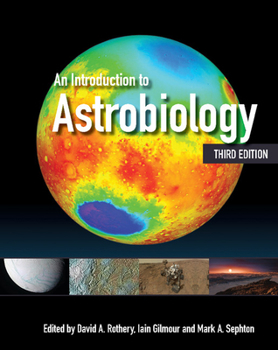
An Introduction to Astrobiology
(Book #2 in the S283 - Planetary science and the search for life Series)

Select Format
Select Condition 
Book Overview
How did life on Earth begin? How common is it elsewhere in the Universe? Written and edited by planetary scientists and astrobiologists, this undergraduate-level textbook provides an introduction to the origin and nature of life, the habitable environments in our solar system and the techniques most successfully used for discovery and characterisation of exoplanets. This third edition has been thoroughly revised to embrace the latest developments in this field. Updated topics include the origins of water on Earth, the exploration of habitable environments on Mars, Europa and Enceladus, and the burgeoning discoveries in exoplanetary systems. Ideal for introductory courses on the subject, the textbook is also well-suited for self-study. It highlights important concepts and techniques in boxed summaries, with questions and exercises throughout the text, with full solutions provided. Online resources, hosted at www.cambridge.org/features/planets, include selected figures from the book, self-assessment questions and sample tutor assignments.
Format:Paperback
Language:English
ISBN:110843083X
ISBN13:9781108430838
Release Date:March 2018
Publisher:Cambridge University Press
Length:398 Pages
Weight:2.55 lbs.
Dimensions:0.9" x 8.2" x 10.3"
Customer Reviews
2 ratings
An Excellent Introduction into Astrobiology
Published by Thriftbooks.com User , 16 years ago
Twenty-five years ago the study of astrobiology was quite "fringe". Much has occurred since then, as technology has continually improved and we have taken further, somewhat less tentative steps off this planet. We now have claims of life in a Martian meteorite (not yet accepted), the discovery of over 400 exoplanets to-date (and counting), and interesting possibilities for possible life that may yet be found on Mars (under the surface), Europa (in a putative ocean) and possibly on Titan (assuming life could adapt to the extreme cold there). This book by Gilmour and Sephton presents the study of Astrobiology in a very straightforward and concise way, offering the reader an introductory look into this burdgeoning area of study. In particular, the textbook includes (a) early chapters on the origin of life and on habitability (ie., in "water" zones about planets and otherwise based on other mechanisms about planetary satellites), and (b) a great overview of Earth's extremeophiles. The textbook includes expanded chapters on Mars, Europa and Titan, where the authors go into greater detail on the possibilities for life on these bodies. The book concludes with chapters devoted to the potentiality of life on exoplanets, including yet-to-be-discovered exo-Earths. I read the Gilmour text alongside three other books on this subject - (a) "The Living Cosmos" by Chris Impey, (b) "Astrobiology: A Multidisciplinary Approach" by Jonathan Lunine, and (c) "Looking for Life: Searching the Solar System" by Clancy et. al. The Gilmour and Lunine books would - in my view - be properly classed as true "textbooks" on this subject, while the Impey and Clancy books are presented as more general reading. The Gilmour text is the best introductory textbook to the subject of astrobiology that I have found, and assumes the reader is just starting into the area with limited knowledge. For even greater detail (in a textbook), one can then move on (after Gilmour) to the Lunine text which gives far greater detail, although you will hate all the typos in it. The two other books cited are great expositions of the area in and of themselves, but are presented in a less formal way. Both have been prepared by persons directly involved in the area and both are extremely well-written and a joy to read. These latter books are packed with up-to-date information and indeed go deeper than the Gilmour text does. As such, the latter two references are most easily read for general interest, enjoyment and overview, while the Gilmour text is best used as a clear and concise "textbook" source that organizes all the materials in an introductory and very cogent way. I am sure there are many other texts and sources on their way vis a vis this area, but if you are just starting out, the Gilmour textbook is a good introductory textbook, while the Impey and Clancy books are great reads for people interested in a less formalistic presentation. All four books will give you a good "introductory library"
More astro than biology
Published by Thriftbooks.com User , 21 years ago
This is an excellent textbook, with straightforward problems ... and answers! There's plenty of solid material here and very little fluff. The information is well presented, up-to-date, and easy to read. Three of the nine chapters are about the potential for life elsewhere in our planetary system, in particular on Mars, Europa, and Titan. Another three chapters are on extrasolar planets: how to find them, what we've discovered so far about them, and what signatures of life we might try to look for on them in the future. There's also a chapter on the search for extraterrestrial intelligence (SETI). That leaves two chapters for the definition and origin of life, the Earth's acquisition of the necessary water and carbon, and so on. I'd prefer to see quite a bit more on biology here. I'd like to see much more discussion of the development of multicellular life, the changes in the Earth's environment caused by the production of oxygen, and the evolution of humans. That said, I really liked the chapter on the origin of life. It was illuminating to read about the origin of chirality, written by a specialist in organic matter in meteorites. And I also especially liked the chapters on exoplanets.
Copyright © 2026 Thriftbooks.com Terms of Use
| Privacy Policy | Do Not
Sell/Share My Personal Information | Cookie Policy | Cookie Preferences | Accessibility Statement
ThriftBooks® and the ThriftBooks® logo are registered trademarks of Thrift Books Global, LLC
ThriftBooks® and the ThriftBooks® logo are registered trademarks of Thrift Books Global, LLC
