


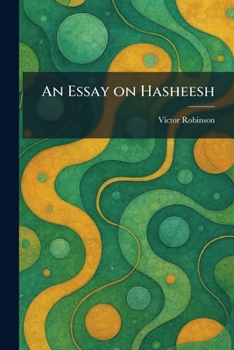
An Essay on Hasheesh

"An Essay on Hasheesh" is a pioneering exploration into the pharmacological and psychological effects of cannabis, written by the esteemed medical historian Victor Robinson. Part scientific inquiry and part literary narrative, this work delves into the historical use of the drug while providing a vivid, first-hand account of the author's own experiments with its consumption. Robinson examines the altered states of consciousness, sensory distortions, and the complex interplay between the mind and the substance, blending clinical observation with a lyrical prose style.
Beyond personal experience, the book traces the cultural and medical perceptions of hashish during the early 20th century. It offers readers an insightful look at the intersection of medicine, chemistry, and human psychology at a time when the scientific community was beginning to systematically study psychoactive compounds. "An Essay on Hasheesh" remains a significant historical document for those interested in the history of medicine, the evolution of pharmacology, and the long-standing human fascination with mind-altering substances. Its rigorous yet accessible approach provides a foundational perspective on the study of cannabis and its effects on the human spirit and intellect.
This work has been selected by scholars as being culturally important, and is part of the knowledge base of civilization as we know it. This work was reproduced from the original artifact, and remains as true to the original work as possible. Therefore, you may see the original copyright references, library stamps (as most of these works have been housed in our most important libraries around the world), and other notations in the work.
This work is in the public domain in the United States of America, and possibly other nations. Within the United States, you may freely copy and distribute this work, as no entity (individual or corporate) has a copyright on the body of the work.
As a reproduction of a historical artifact, this work may contain missing or blurred pages, poor pictures, errant marks, etc. Scholars believe, and we concur, that this work is important enough to be preserved, reproduced, and made generally available to the public. We appreciate your support of the preservation process, and thank you for being an important part of keeping this knowledge alive and relevant.
Customer Reviews
ThriftBooks ® and the ThriftBooks ® logo are registered trademarks of Thrift Books Global, LLC
