


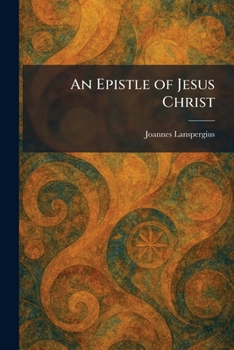
An Epistle of Jesus Christ

Select Format
Select Condition 
Book Overview
'An Epistle of Jesus Christ' is a profound work of Christian devotional literature written by the Carthusian monk Joannes Lanspergius. Presented as a series of intimate instructions from Christ to the 'faithful soul, ' this spiritual classic offers guidance on the path toward holiness, humility, and divine love. The text is structured as a direct dialogue, providing the reader with a meditative framework for self-reflection and spiritual growth.
Rooted in the ascetic traditions of the Carthusian Order, the work emphasizes the importance of inner peace, the renunciation of worldly distractions, and the cultivation of a personal relationship with the Divine. Lanspergius's prose is both gentle and challenging, encouraging the soul to embrace the virtues of patience, charity, and obedience. Its timeless appeal lies in its focus on the interior life, making it a significant contribution to Catholic mystical theology.
As a notable example of 16th-century spiritual writing, 'An Epistle of Jesus Christ' serves as both a practical manual for Christian living and a literary testament to the enduring quest for spiritual perfection. Its insights into the human condition and the nature of faith continue to resonate with readers seeking a deeper understanding of religious devotion and the contemplative life.
This work has been selected by scholars as being culturally important, and is part of the knowledge base of civilization as we know it. This work was reproduced from the original artifact, and remains as true to the original work as possible. Therefore, you may see the original copyright references, library stamps (as most of these works have been housed in our most important libraries around the world), and other notations in the work.
This work is in the public domain in the United States of America, and possibly other nations. Within the United States, you may freely copy and distribute this work, as no entity (individual or corporate) has a copyright on the body of the work.
As a reproduction of a historical artifact, this work may contain missing or blurred pages, poor pictures, errant marks, etc. Scholars believe, and we concur, that this work is important enough to be preserved, reproduced, and made generally available to the public. We appreciate your support of the preservation process, and thank you for being an important part of keeping this knowledge alive and relevant.
Customer Reviews
ThriftBooks ® and the ThriftBooks ® logo are registered trademarks of Thrift Books Global, LLC
