


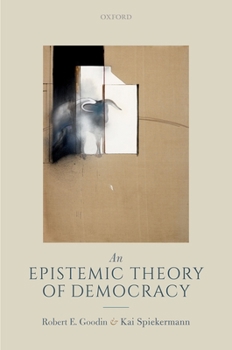
An Epistemic Theory of Democracy
No Customer Reviews

Democracy has many attractive features. Among them is its tendency to track the truth, at least under certain idealized assumptions. That basic result has been known since 1785, when Condorcet published his famous jury theorem. But that theorem has typically been dismissed as little more than a mathematical curiosity, with assumptions too restrictive for it to apply to the real world. In An Epistemic Theory of Democracy, Goodin and Spiekermann propose different ways of interpreting voter independence and competence to make jury theorems more generally applicable. They go on to assess a wide range of familiar political practices and alternative institutional arrangements, to determine what constellation of them might most fully exploit the truth-tracking potential of majoritarian democracy. The book closes with a discussion of how epistemic democracy might be undermined, using as case studies the Trump and Brexit campaigns.
Format:Hardcover
Language:English
ISBN:0198823452
ISBN13:9780198823452
Release Date:July 2018
Publisher:Oxford University Press, USA
Length:480 Pages
Weight:1.94 lbs.
Dimensions:1.4" x 6.0" x 9.2"
Customer Reviews
0 rating
Copyright © 2026 Thriftbooks.com Terms of Use
| Privacy Policy | Do Not
Sell/Share My Personal Information | Cookie Policy | Cookie Preferences | Accessibility Statement
ThriftBooks® and the ThriftBooks® logo are registered trademarks of Thrift Books Global, LLC
ThriftBooks® and the ThriftBooks® logo are registered trademarks of Thrift Books Global, LLC
