


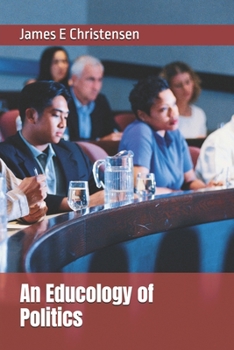
An Educology of Politics
No Customer Reviews

Educology is the fund of knowledge about education, and the educology of politics is a subfund of educology. It is the fund of knowledge about the effects of political activity upon education. Education is the field of phenomena in which someone teaches and someone studies intentionally under guidance some content such that the student will learn intentionally under guidance some prescribed range of knowing as specified by some intended learning outcome. Education can be official (with certified teachers, written lesson plans, unit plans, syllabi, curricula, assessments, evaluations, diplomas, degrees, etc.) and unofficial (teaching and studying without those features). The activities of teaching and studying intentionally under guidance are always done within a context. The context includes the physical circumstances, cultural milieu and social setting and in which teachers and students conduct their activities. The social setting includes, among other things, people who conduct themselves politically. The politics of education is the set of activities which individuals and groups undertake to compete with each other to achieve authority, power and control to make laws, policies and rules for education, and especially for official education. There is political activity intended to influence and/or control all levels of official education (preprimary, primary, secondary and tertiary). The politics of education functions as a system in which there are essential elements, all standing in relation to each other. The essential elements are people who play the role of protagonists, supporters of protagonists, antagonists, supporters of antagonists, neutral parties and decision makers. It is typical to find at least four attitudes among those engaged in the politics of education - reactionary, conservative, progressive, radical reformist.Protagonists and antagonists of all attitudes and persuasions use both coercive and noncoercive means to achieve authority and/or power to influence and/or control decisions made about education (and especially official education). The effects of political activities upon education include at least four possibilities - sustaining, constructive, reconstructive or destructive results. The genesis of educational politics is from two sources. One generates political attitudes and activities which function to produce social and cultural inertia that maintains the status quo in education as well as in other features of a society and culture. The second source generates political attitudes and activities which function to produce social and cultural innovation.
Format:Paperback
Language:English
ISBN:B0DZW34D12
ISBN13:9798313489698
Release Date:March 2025
Publisher:Independently Published
Length:346 Pages
Weight:1.02 lbs.
Dimensions:0.8" x 6.0" x 9.0"
Customer Reviews
0 rating
Copyright © 2026 Thriftbooks.com Terms of Use
| Privacy Policy | Do Not
Sell/Share My Personal Information | Cookie Policy | Cookie Preferences | Accessibility Statement
ThriftBooks® and the ThriftBooks® logo are registered trademarks of Thrift Books Global, LLC
ThriftBooks® and the ThriftBooks® logo are registered trademarks of Thrift Books Global, LLC
