


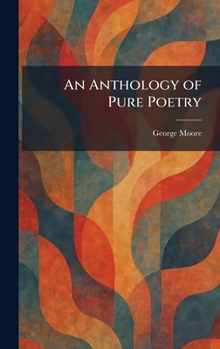
An Anthology of Pure Poetry

Select Format
Select Condition 
Book Overview
"An Anthology of Pure Poetry" is a curated collection compiled by the influential writer George Moore, aimed at defining and showcasing the concept of 'pure poetry.' Moore's selection focuses on verse characterized by its objective beauty and imaginative power, intentionally excluding poems that are overly didactic, philosophical, or preoccupied with the poet's personal emotions. By prioritizing imagery and the musicality of language, the collection seeks to present poetry in its most essential form.
The volume features a diverse array of English verse, ranging from the Elizabethan era through the 19th century, including works by masters such as William Shakespeare, John Keats, and Percy Bysshe Shelley. In his substantial introductory essay, Moore articulates his aesthetic theory, arguing that true poetry should evoke a world of objective beauty rather than serve as a vehicle for moral or social commentary. "An Anthology of Pure Poetry" remains a significant contribution to literary criticism and a fascinating window into the aesthetic movement of the early 20th century. It offers readers a refined perspective on the enduring power of the lyrical voice and the meticulous craft of verse.
This work has been selected by scholars as being culturally important, and is part of the knowledge base of civilization as we know it. This work was reproduced from the original artifact, and remains as true to the original work as possible. Therefore, you may see the original copyright references, library stamps (as most of these works have been housed in our most important libraries around the world), and other notations in the work.
This work is in the public domain in the United States of America, and possibly other nations. Within the United States, you may freely copy and distribute this work, as no entity (individual or corporate) has a copyright on the body of the work.
As a reproduction of a historical artifact, this work may contain missing or blurred pages, poor pictures, errant marks, etc. Scholars believe, and we concur, that this work is important enough to be preserved, reproduced, and made generally available to the public. We appreciate your support of the preservation process, and thank you for being an important part of keeping this knowledge alive and relevant.
Customer Reviews
ThriftBooks ® and the ThriftBooks ® logo are registered trademarks of Thrift Books Global, LLC
