


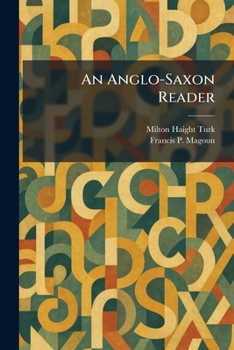
An Anglo-Saxon Reader

Select Format
Select Condition 
Book Overview
"An Anglo-Saxon Reader" serves as a comprehensive gateway into the linguistic and literary heritage of early England. Edited by scholars Milton Haight Turk and Francis P. Magoun, Jr., this collection provides students and philologists with a curated selection of essential texts from the Old English period. The volume spans a diverse array of genres, including legal codes, historical chronicles, and profound poetic works that define the Anglo-Saxon era.
This anthology is designed to facilitate a deep understanding of the evolution of the English language. It includes significant prose excerpts from the "Anglo-Saxon Chronicle" and the laws of Alfred the Great, alongside enduring masterpieces of verse. By presenting these works in their original tongue, the reader offers an immersive experience into the heroic culture and intellectual life of the Middle Ages. Each selection is chosen for its linguistic clarity and historical significance, making it an indispensable resource for anyone seeking to master Old English grammar, syntax, and vocabulary.
Whether used as a classroom textbook or for independent study, "An Anglo-Saxon Reader" remains a vital cornerstone in the study of Germanic linguistics and medieval history. It preserves the foundational voices of English literature, bridging the gap between the ancient past and the modern linguistic landscape.
This work has been selected by scholars as being culturally important, and is part of the knowledge base of civilization as we know it. This work was reproduced from the original artifact, and remains as true to the original work as possible. Therefore, you may see the original copyright references, library stamps (as most of these works have been housed in our most important libraries around the world), and other notations in the work.
This work is in the public domain in the United States of America, and possibly other nations. Within the United States, you may freely copy and distribute this work, as no entity (individual or corporate) has a copyright on the body of the work.
As a reproduction of a historical artifact, this work may contain missing or blurred pages, poor pictures, errant marks, etc. Scholars believe, and we concur, that this work is important enough to be preserved, reproduced, and made generally available to the public. We appreciate your support of the preservation process, and thank you for being an important part of keeping this knowledge alive and relevant.
Customer Reviews
ThriftBooks® and the ThriftBooks® logo are registered trademarks of Thrift Books Global, LLC
