
Skip to content
Scan a barcode
Scan
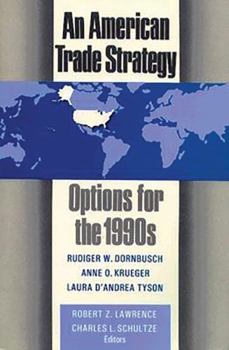
Paperback An American Trade Strategy: Options for the 1990s Book

ISBN: 0815751796

ISBN13: 9780815751793

An American Trade Strategy: Options for the 1990s

The world trading envionment changed dramatically in the 1980s. America's trade balance declined sharply, while Japan, Germany, and the newly industrialized countries of Asia built up large, continuing surpluses. Such developments led many people to question whether the traditional postwar strategy of reliance on multilateral free trade agreements is still the best course for the United States, or even a viable one.
The challenges to the multilateral system are both practical and theoretical. Various nations are already forming ""free trade"" blocs-- notably the Europe 1992 and the Canadian-American trade arrangements. The United States has increasingly bypassed the GATT and bargained bilaterally in trade disputes, especially with Japan. Several prominent economists have developed new theories that support a more active role for the government to help shape technological change and improve the competitive position of the United States in world markets. Others strongly defend the current arrangements and caution that greater reliance on bilateral bargaining and trading blocs will lead to fragmented world trade and cartel-like arrangements among a few major producers. They are even more skeptical of an interventionist government successfully ""managing"" trade.
An American Trade Strategy assesses options for the decade ahead, examining the case for mulitlateral free trade, aggressive bilateralism, and managed trade, as well as their shortcomings. The editors and contributors evaluate the alternative strategies and reflect on their implications for the future direction of American trade policy.

Recommended

Format: Paperback

Condition: New

$33.19
Ships within 2-3 days
Save to List

Customer Reviews

1 rating

Review of "An American Trade Strategy"

This book came about as a result of the public debate about the direction of United States trade policy. In September of 1989, the Brookings Institution put together a conference entitled An American Trade Strategy: Options for the 1990s. The three main papers presented at the conference each defended an alternative policy approach, namely multilateral free trade, aggresive bilateralism and managed trade. This tome contains revised versions of these three documents, along with the remarks of the official discussants of each paper and the comments of a panel of three experts. As a bonus, the volume also includes two introductory chapters in which the editors, Robert Lawrence and Charles Schultze, both affiliated with the Brookings Economic Studies Program, sum up and evaluate the strategies at hand, which, by the way, are spoused by Anne Krueger (free trade), Rudiger Dornbusch (bilateral trade) and Laura Tyson (managed trade).Lawrence and Schultze, in assessing the different arguments and proposals put forth in regards to the aforementioned central issue of the book, first evaluate the two chief objectives -- improvement in the terms of trade and strategic industrial policy -- and then turn their attention to the various means suggested for their attainment.Traditional economic analysis suggests that free trade is the best approach to raise global welfare. Given the importance of the US in the global economy, this country's actions are likely to have systemic repercussions. Protectionist policies by the US might prompt other nations into taking defensive and retaliatory actions. As long as other countries help companies that produce goods America imports, the US gains. But if countries subsidize their exports to third markets or protect domestic firms against US exports, they can lower US living standards.On the other hand, Dornbusch believes that the informal, mainly nongovernmental, barriers to imports into Japan have biased the terms of trade against the US. He claims that the negotiation of free trade areas with other US trading partners might put pressure on Japan to agree to trade concessions in the form of increasing its imports of US goods. Dornbusch is not explicitly concerned about the specific composition of US exports. Therefore, when he proposes the negotiation of numerical goals for the expansion of imports into Japan, he envisages an aggregate target for manufactured goods.Tyson contends that some industries are more important than others. She voices two concerns: that market forces left to their own devices will not channel enough resources into the critical high-technology industries, and that the trade and industrial policies of other countries will drive US producers out of these key sectors and thus lower US living standards.According to Tyson, there are three principal kinds of departures from the scenario of efficiently functioning markets that make some industries ''more equal than others'' and that warrant intervention
Copyright © 2026 Thriftbooks.com Terms of Use | Privacy Policy | Do Not Sell/Share My Personal Information | Cookie Policy | Cookie Preferences | Accessibility Statement
ThriftBooks ® and the ThriftBooks ® logo are registered trademarks of Thrift Books Global, LLC

GoDaddy Verified and Secured