


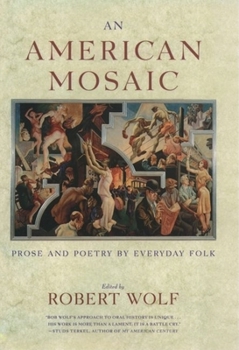
An American Mosaic: Prose and Poetry by Everyday Folk


Select Format
Select Condition 
Book Overview
From Walt Whitman's catalog of America to Thomas Hart Benton's American epics painted on walls across the country to Studs Terkel's documentaries, much artistic and literary labor has stemmed from the urge to figure out what makes this country tick. Any attempt at so large a canvas as this disparate country will be fragmented and incomplete, but like Benton's 1932 mural "American Today", American Mosaic is composed of pieces that taken together provide a vivid look at vanishing scenes of American life.
Here, Robert Wolf offers a collective autobiography of the American heartland written for the most part by everyday men and women without literary ambition. Focusing on the second half of the twentieth century, this collection of essays, short stories, poems, and memoirs--woven together with Wolf's introductory notes--is the culmination of nine years of Free River Press writing workshops conducted by Wolf for the purpose of documenting contemporary American life.
The volume includes work from homeless men and women from Tennessee, small farmers in rural Iowa, residents of Midwestern small towns, the Mississippi Delta, and river communities on the Mississippi. These first-person, eyewitness accounts offer glimpses of daily life: the farmers' struggles against large corporations; poetic meditations on life in the streets, on the road, and in prison; tall tales of river town saloons; and the social rituals of cooking, town hall and party phone lines across America's small towns. Among many narratives, American Mosaic gives us the ruminations of a homeless woman over a martini in El Gilbert's poem "Drunk," descriptions of hearty, communal meals during the July harvest in Clara Leppert's piece "Meals for Threshers," a picture of the goings-on in a West Helena, Arkansas juke joint with Chris Crawford's essay "Lucky Lacey," and the reminiscences of a former Mississippi River towboat captain in Jack Libby's "The Midnight Watch Change."
Together, these diverse stories comprise panels of a literary mural of America. American Mosaic is a compelling testament to regional and local American voices and folkways which are fast disappearing through the relentless push towards a global economy and culture.
Here, Robert Wolf offers a collective autobiography of the American heartland written for the most part by everyday men and women without literary ambition. Focusing on the second half of the twentieth century, this collection of essays, short stories, poems, and memoirs--woven together with Wolf's introductory notes--is the culmination of nine years of Free River Press writing workshops conducted by Wolf for the purpose of documenting contemporary American life.
The volume includes work from homeless men and women from Tennessee, small farmers in rural Iowa, residents of Midwestern small towns, the Mississippi Delta, and river communities on the Mississippi. These first-person, eyewitness accounts offer glimpses of daily life: the farmers' struggles against large corporations; poetic meditations on life in the streets, on the road, and in prison; tall tales of river town saloons; and the social rituals of cooking, town hall and party phone lines across America's small towns. Among many narratives, American Mosaic gives us the ruminations of a homeless woman over a martini in El Gilbert's poem "Drunk," descriptions of hearty, communal meals during the July harvest in Clara Leppert's piece "Meals for Threshers," a picture of the goings-on in a West Helena, Arkansas juke joint with Chris Crawford's essay "Lucky Lacey," and the reminiscences of a former Mississippi River towboat captain in Jack Libby's "The Midnight Watch Change."
Together, these diverse stories comprise panels of a literary mural of America. American Mosaic is a compelling testament to regional and local American voices and folkways which are fast disappearing through the relentless push towards a global economy and culture.
Format:Hardcover
Language:English
ISBN:0195132645
ISBN13:9780195132649
Release Date:June 1999
Publisher:Oxford University Press
Length:352 Pages
Weight:1.30 lbs.
Dimensions:8.3" x 1.4" x 5.8"
Customer Reviews
5 ratings
The Voices From Under the Bridge
Published by Thriftbooks.com User , 24 years ago
Wolf's signature contribution to American Letters is that he records the voices overlooked by the vast majority of literary scholars. The custom of literature professors is to read and teach only the titles that appear on the best sellers list.An American Mosaic: Prose and Poetry by Everyday Folks validates the voices from under the bridge. The homeless, prison inmates and Delta characters have no concept of first printing, publicity tours and critical reviews. Their voices accurately describe the deep currents of American life where real people are trying to keep their heads above water as they are swept along to an unknown American destiny.As a reader, the selections are immediately accessible to all students who hear the ring of truth as the voices of farmers and rural residents cascade downstream in the American experience. Because the poems and prose pieces were not written to capture a share of the vast reader's market, the untrained authors write authentically as if they are in private conversation with real folks.American Mosaic is also a great anthology for high school and college writing classes because students can easily pattern the natural rhythmns and tones of everyday people. American Mosaic's authors are not celebrities, many are not even good writers. Yet what they have written carries a valid reporting of real life. As one student blurted out, "I go to a church exactly like the one in "Church House Blues.An American Mosaic is a must read and teach for writing and literature teachers desperate to find a text that a diverse student population can relate to. Bob Wolf has captured the very voice of Americans...Americans looking for an anchor in a safe harbor,Joseph W. Warren, PhDEnglish DepartmentAndrews UniversityBerrien Springs, MI 49104
"Voices of Intriguing Characters"
Published by Thriftbooks.com User , 24 years ago
Robert Wolf, editor of American Mosaic, a wonderful collection of poetry, prose, short stories, essays and commentaries by ordinary people whose wisdom and grace are eaily ignored in contemporary American intellectual life, believes that anyone who can tell a story can write one. To prove his point, Wolf has undertaken a life's work of itinerant writing workshops, going to and settling in with people whose stories illuminate the vitality and struggles of daily life in small towns in rural Iowa, the Mississippi Delta, and river communities along the Mississippi from Iowa to Louisiana. Just as David Isay's and Stacy Abramson's powerful "Sound Portraits" on National Public Radio have given voice to a disparate array of unexpected and intriguing characters, Wolf's writing workshops produce first-person accounts of what it means to be an American--accounts which permit readers to escape the stereotypical portraits of the homeless, the rural poor, and the hidden denizens of small towns in America too frequently proffered by our mass media as truthful representations of American folksiness. "Fragmentation, I have often thought, is the driving force of our time," writes Wolf in one of his commentaries in American Mosaic, "far more powerful than any integrating force." As Executive Director of Free River Press, the sponsor of these writing workshops which produced the book, Wolf has responded to his own critique by making the effort to bring people together, integrating their stories, rituals, and struggles with the sensibilities of readers who may never meet the people who grow the food for our tables, but through American Mosaic are given the opportunity to acknowledge their dignity, courage, and integrity.
American Mozaic Has real relivance
Published by Thriftbooks.com User , 26 years ago
American Mozaic is an interesting collection of storys from every day people around america. These storys although in some cases dull enlighten the average american on the hopes and plights of other working class americans. It is a book that has real relivance in todays society. We tend to get caught up in the glamorous and not so glamorous lives of media stars and forget that the country is really kept running by the american worker. This book shows in more ways then one, that the guy who runs the ice cream stand down the street is just as relivant and important in todays society as the bank teller that puts your pay check in your account every month. This is an important book to read if you feel you are starting to loose touch with america and americans today.
GSB Student Review
Published by Thriftbooks.com User , 26 years ago
After reading American Mosaic in my 20th Century Documentary Studies class, it made me realize how very different our society today is from the past. I enjoyed hearing about the way people just spontaneously picked up and traveled across America. Today, this would be something that would be very hard because of many issues; work, family, money, and most of all the citizens of the US. The things that these travelers experienced are wonderful things to read and think about. Wolf wonderfully portrays the American working man in his habitat. All of the stories are true, and told by real people. This makes the book even more interesting to know that all of the events really did happen. From accounts told by homeless people, to poems written by former inmates, this book covers the many different views and thoughts of American life. This book could easily bring back the memories of a person that lived through those times. Robert Wolf started this book when he ran a writing workshop, MATTHEW 25. Located on the corner of 8th Street and Broadway, it was the ideal place to view the life on the streets. This workshop in downtown Nashville was made for homeless writers to let their thoughts fly. After 2 years the workshop closed, but Wolf was left with wonderful memories and some excellent literature and prose.
A must read for any everyday folk!
Published by Thriftbooks.com User , 26 years ago
Ameican Mosaic is an excellent book which on many levels portrays the often overlooked plight of the common american. It gives the voice of prose to common modern farmers to tugboat captains and even the homeless, who, in today's society are all too often overlooked. Without books like American Mosaic history would only give us access to stories of great valour and achievement. However these people and moments are far below the surface of true america, it is the characters represented in American Mosaic who are, in fact the skin of this country. Those who are represented in American Mosaic are definitely people whose opinion on life and our nation deserve to be heard. It is rare for a homeless man who has spent a good deal of time in mental institutes to be given a forum where his words can reach all of the general public. Howebver this is made possible through this collection of works. Shockingly enough, said person has many fascinating, if uncommon, views on politics, freedom, and society. Though I found the stories of the vagabonds to be the most intriguing, because of the romance I connect with their lifestyle, almost all of the entries were interesting enough to keep my fullest attention. There were some parts which lacked action, mainly the parts about modern farming. However to someone who is interested in this topic these would be fascinating readings. The tugboat captains entry was fascinating for me becaus of my inherent interest in the sea. That it possibly why this book is so intriguing: it has some common wisdom from everyday people for everyday people!
Copyright © 2026 Thriftbooks.com
Terms of Use | Privacy Policy | Do Not Sell/Share My Personal Information | Cookie Policy | Cookie Preferences | Accessibility Statement
ThriftBooks ® and the ThriftBooks ® logo are registered trademarks of Thrift Books Global, LLC
ThriftBooks ® and the ThriftBooks ® logo are registered trademarks of Thrift Books Global, LLC
