


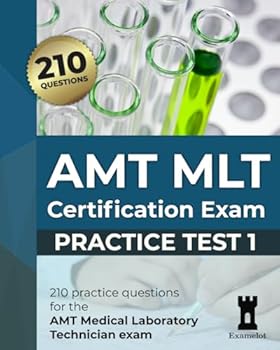
AMT MLT Certification Exam: Practice Test 1
No Customer Reviews

Prepare for the AMT Medical Laboratory Technician (MLT) exam with this unofficial book of practice questions. This book contains: * 210 multiple-choice questions * Information about the AMT MT exam The questions are divided into nine sections based on the nine Work Areas of the exam: 1. General Laboratory 2. Chemistry 3. Hematology 4. Coagulation and Hemostasis 5. Immunology and Serology 6. Immunohematology 7. Blood Banking and Transfusion Services 8. Microbiology 9. Urinalysis and Body Fluids Answers can be found at the end of each practice test, along with an explanation for trickier questions. SAMPLE QUESTIONS To give you a preview, here are five sample questions from the book: 1) GENERAL LABORATORY When drawing blood from an obese patient, which location should be the first place you look for a vein? a. The antecubital fossa b. The back of the hand c. The back of the knee d. The feet 2) CHEMISTRY If a blood sample is accidentally taken in an EDTA tube instead of a heparin tube, which of these test results would be affected? a. Calcium b. Cholesterol c. Glucose d. TSH 3) HEMATOLOGY Which colour vacutainer tube is called the erythrocyte sedimentation rate tube? a. Black b. Green c. Red d. White 4) COAGULATION AND HEMOSTASIS Which pathway is also known as the contact activation pathway? a. Common pathway b. Extrinsic pathway c. Intrinsic pathway d. Tissue factor pathway 5) IMMUNOLOGY AND SEROLOGY Which immune system cells destroy infected or malignant host cells? a. B lymphocytes b. Natural killer cells c. Neutrophils d. T lymphocytes 6) IMMUNOHEMATOLOGY Antibody class is determined by the: a. constant region of the heavy chain b. constant region of the light chain c. disulfide bonds d. variable region of the heavy chain 7) BLOOD BANKING AND TRANSFUSION SERVICES In humans, the major histocompatibility complex is also called the _____ system. a. EHP b. GOW c. HLA d. IRH Answers 1) a. The antecubital fossa When drawing blood from obese patients, check the antecubital area First. Obese patients often have an easily palpable median cubital vein. 2) a. Calcium EDTA tubes contain EDTA as an anticoagulant to prevent blood samples from clotting. EDTA works by binding to calcium − without calcium, blood cannot clot. However, this also means EDTA tubes should not be used to measure blood calcium levels because the EDTA would bind to the calcium and interfere with the results. 3) a. Black The black top tube, also known as the erythrocyte sedimentation rate (ESR) tube, is designed specifically for ESR tests. Lavender top tubes (EDTA tubes) can also be used for ESR tests and are now a widely accepted alternative to black top tubes. 4) c. Intrinsic pathway The intrinsic pathway is also known as the contact activation pathway. The tissue factor pathway is another name for the extrinsic pathway. 5) b. Natural killer cells 6) a. constant region of the heavy chain An antibody's class is determined by the constant region of its heavy chain. This region creates the Fc region, which is vital for binding to Fc receptors on other cell types and mediating antibody functions. 7) c. HLA The HLA (human leukocyte antigen) system is a group of genes that code for immune system proteins. It is also called the major histocompatibility complex.
Format:Paperback
Language:English
ISBN:B09N1238Z8
ISBN13:9798782480776
Release Date:December 2021
Publisher:Independently published
Length:90 Pages
Weight:0.57 lbs.
Dimensions:10.0" x 0.2" x 8.0"
Customer Reviews
0 rating
Copyright © 2026 Thriftbooks.com Terms of Use
| Privacy Policy | Do Not
Sell/Share My Personal Information | Cookie Policy | Cookie Preferences | Accessibility Statement
ThriftBooks® and the ThriftBooks® logo are registered trademarks of Thrift Books Global, LLC
ThriftBooks® and the ThriftBooks® logo are registered trademarks of Thrift Books Global, LLC
