


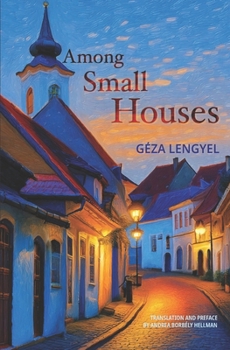
Among Small Houses
No Customer Reviews

Among Small Houses invites us into the quiet corners of provincial Hungarian life, where two old friends reunite on streets that feel both familiar and strange. L szl Cs szi arrives with ambition crackling around him like electrical current-his plans for the town's power plant carrying more voltage than mere infrastructure. Jenő Gyur cz has settled here too, an art teacher whose dreams have faded to watercolor whispers, his talents diluted by caution and compromise.
Their paths, once parallel, now converge upon Aranka G briel-a young woman standing at her own crossroads, peering down the avenues of possibility with curiosity and trepidation. She hovers between convention and self-discovery, uncertain which lamp to follow into her future. Through their triangular orbit, Lengyel illuminates the choices that define us: to reach boldly or withdraw cautiously, to electrify one's surroundings or adapt to existing currents.
The novel finds its rhythm in the space between old and new. R vpart's dusty streets and proper drawing rooms become the stage where modernity makes its first tentative appearance, not with grand declarations but with calculations, permits, and the whispered politics of progress. The electric plant, with its promise of light in previously dark corners, serves as more than plot-it illuminates the characters' inner landscapes as well.
Wit shines through the lemonade and wine glasses. Town officials gather importance around themselves like parlor chairs pulled too close to the fire, social climbers practice their performances of refinement, and affairs conducted in "red salons" maintain the transparent fiction of secrecy. This first English translation preserves the incisive voice with which Lengyel observed his world-a world standing at the edge of transformation, not yet aware of how completely it would soon change.
Lengyel's portrayal of provincial social hierarchies, economic circumstances, and psychological struggles makes this work a valuable historical document and an engaging study of human aspiration at a pivotal moment in European history.
About the Author
G za Lengyel (1881-1967) was a Hungarian writer, critic, and economist whose work spanned from the Belle poque through the Communist era. Born G za L winger, he trained as an architect before turning to journalism and literature. A prominent contributor to the influential journal Nyugat, Lengyel authored works on Hungarian press, economics, and cultural figures. His long life positioned him as a witness to Hungary's dramatic transformations through two world wars and multiple political regimes.
Their paths, once parallel, now converge upon Aranka G briel-a young woman standing at her own crossroads, peering down the avenues of possibility with curiosity and trepidation. She hovers between convention and self-discovery, uncertain which lamp to follow into her future. Through their triangular orbit, Lengyel illuminates the choices that define us: to reach boldly or withdraw cautiously, to electrify one's surroundings or adapt to existing currents.
The novel finds its rhythm in the space between old and new. R vpart's dusty streets and proper drawing rooms become the stage where modernity makes its first tentative appearance, not with grand declarations but with calculations, permits, and the whispered politics of progress. The electric plant, with its promise of light in previously dark corners, serves as more than plot-it illuminates the characters' inner landscapes as well.
Wit shines through the lemonade and wine glasses. Town officials gather importance around themselves like parlor chairs pulled too close to the fire, social climbers practice their performances of refinement, and affairs conducted in "red salons" maintain the transparent fiction of secrecy. This first English translation preserves the incisive voice with which Lengyel observed his world-a world standing at the edge of transformation, not yet aware of how completely it would soon change.
Lengyel's portrayal of provincial social hierarchies, economic circumstances, and psychological struggles makes this work a valuable historical document and an engaging study of human aspiration at a pivotal moment in European history.
About the Author
G za Lengyel (1881-1967) was a Hungarian writer, critic, and economist whose work spanned from the Belle poque through the Communist era. Born G za L winger, he trained as an architect before turning to journalism and literature. A prominent contributor to the influential journal Nyugat, Lengyel authored works on Hungarian press, economics, and cultural figures. His long life positioned him as a witness to Hungary's dramatic transformations through two world wars and multiple political regimes.
Format:Paperback
Language:English
ISBN:B0F38PR15L
ISBN13:9798316311699
Release Date:April 2025
Publisher:Independently Published
Length:224 Pages
Weight:0.52 lbs.
Dimensions:0.5" x 5.3" x 8.0"
Customer Reviews
0 rating
Copyright © 2026 Thriftbooks.com Terms of Use
| Privacy Policy | Do Not
Sell/Share My Personal Information | Cookie Policy | Cookie Preferences | Accessibility Statement
ThriftBooks® and the ThriftBooks® logo are registered trademarks of Thrift Books Global, LLC
ThriftBooks® and the ThriftBooks® logo are registered trademarks of Thrift Books Global, LLC
