


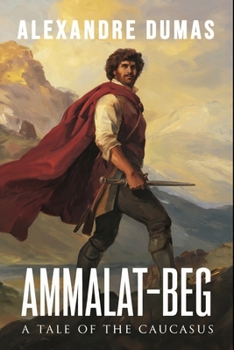
Ammalat-Beg: A Tale of the Caucasus: A New Translation

The story was already legendary by the time Dumas heard it. Ammalat-Beg - Avar nobleman, prot g of a Russian colonel named Verkhovsky, a man being slowly remade by the empire that had absorbed his homeland - had killed the man who befriended him. The reasons were political, personal, and irreducible to either; the act had reverberated through the Russian officer class and the literary imagination of the Caucasus for decades. Alexander Bestuzhev-Marlinsky, himself an exile soldier in the region, had already made it the subject of one of the most celebrated Russian romantic tales of the 1830s.
When Dumas arrived in the Caucasus in 1858 - the war between Russia and the mountain peoples finally drawing to its close after nearly four decades - he came with that story already in his mind and the actual landscape before him. What he produced from the encounter is neither simple adaptation nor independent invention but something characteristic of his best work: a retelling that inhabits its source from the inside, bringing the moral weight of a real historical tragedy into contact with his own gifts for atmosphere, character, and the dramatic rendering of impossible choices.
Ammalat-Beg is a man caught between civilizations at the moment of their most violent collision - given, by the Russian empire's cultural colonialism, a transformation he did not ask for and cannot complete, and forced eventually to a choice whose cost falls on the one person who had offered him genuine friendship. The landscape around him is the Caucasus in the final years of a war that had consumed a generation: vast, beautiful, and saturated with a history of resistance that gives every personal decision a political weight.
One of Dumas' most overlooked and most serious works - and one of the few in which the politics of empire are not backdrop but subject.
Related Subjects
Fiction History Literary Literary Criticism & Collections Literature Literature & FictionCustomer Reviews
ThriftBooks® and the ThriftBooks® logo are registered trademarks of Thrift Books Global, LLC
