


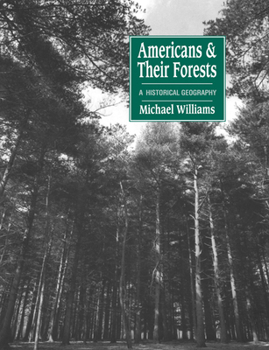
Americans and Their Forests: A Historical Geography

Select Format
Select Condition 
Book Overview
When Europeans first reached the land that would become the United States they were staggered by the breadth and density of the forest they found. The existence of that forest, and the effort either to use or subdue it, have been constant themes in American history, literature, economics, and geography up to the meaning of the forest in American history and culture, he describes and analyzes the clearing and use of the forest from pre-European times to the present, and he traces the subsequent regrowth of the forest since the middle of the twentieth century. Dr Williams begins by exploring the role of the forest in American culture: the symbols, themes, and concepts - for example, pioneer woodsman, lumberjack, wilderness - generated by contact with the vast land of trees. He considers the Indian use of the forest, describing the ways in which native tribes altered it, primarily through fire, to promote a subsistence economy. Early European settlers, he shows, extracted many products from the forest, and also began the extensive clearance of trees that would continue for almost three hundred years. Succeeding chapters, organized by topic and region, cover agricultural and industrial effects upon and uses of the forest. Dr Williams explores the rise (and often fall) of industries based upon forest products: naval stores, timber for building, charcoal and the iron industry, the railroads. Attention is devoted to the forests of the Middle West, the South, and the Pacific Northwest. By the late nineteenth century Americans began to realize that the forest was not boundless and moved to preserve those portions, still extensive, that remained. In the wake of the movement for preservation, Dr Williams describes how the forest began to regrow, especially after 1950, in areas where it had originally been vigorous and healthy, a development that continues today.
Format:Paperback
Language:English
ISBN:0521428378
ISBN13:9780521428378
Release Date:June 1992
Publisher:Cambridge University Press
Length:624 Pages
Weight:2.86 lbs.
Dimensions:1.4" x 7.3" x 9.7"
Customer Reviews
2 ratings
A landmark text
Published by Thriftbooks.com User , 18 years ago
This is one of the classics of American environmental history, sitting on the high shelf with Stilgoe's "Common Landscapes of America", Pyne's "Fire in America", Cronon's "Changes in the Land" and "Nature's Metropolis", and Reisner's "Cadillac Desert". Williams does a masterful job of pulling together social and economic sources (including much primary material) to present a wholly original view of American history. For thousands of years people have shaped the forests of North America, and in subtle ways the forests have shaped us. However, forest history has long been hidden behind the curtain of political events that constitute the official record of "history", aided by the amazing shortness of human memory. Williams brings forest history (and environmental history in general) back into the light with a lucid account of forest history at the scale of the whole nation. He dusts off long-forgotten sets of nineteenth and twentieth century statistics, and summarizes them in easily comprehended graphs and maps to make the point that the forest resource played an important role in population expansion across North America, in the evolution of our governmental structure, and in development of modern technologies. To the forest ecologist, he says 'Much of the forest you are looking at today is simply an artifact of human intervention in the past'. Like all works which attempt to convey a long view of history, A & TF becomes a bit vague as it approaches modern day. The owls vs. jobs controversy of the Pacific Northwest is not mentioned, nor are the regrowth of eastern forests and exurban sprawl given the space they deserve. Nevertheless, the accounts of events in the 17th - mid-20th century are excellent, and highly relevant considering we are still dealing with their aftermath.
A history book on forests
Published by Thriftbooks.com User , 18 years ago
Many old pictures tell you the truth. A lot of tables include information of the past. foresters must own this book.
Copyright © 2026 Thriftbooks.com Terms of Use
| Privacy Policy | Do Not
Sell/Share My Personal Information | Cookie Policy | Cookie Preferences | Accessibility Statement
ThriftBooks® and the ThriftBooks® logo are registered trademarks of Thrift Books Global, LLC
ThriftBooks® and the ThriftBooks® logo are registered trademarks of Thrift Books Global, LLC
