


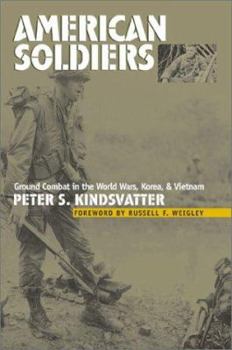
American Soldiers: Ground Combat in the World Wars, Korea, and Vietnam
(Part of the Modern War Studies Series)

Select Format
Select Condition 
Book Overview
Some warriors are drawn to the thrill of combat and find it the defining moment of their lives. Others fall victim to fear, exhaustion, impaired reasoning and despair. This book synthesizes the wartime experiences of American soldiers, from the doughboys of World War I to the grunts of Vietnam. Focusing on both soldiers and marines, it draws on histories and memoirs, oral histories, psychological and sociological studies and even fiction to show that their experiences remain fundamentally the same regardless of the enemy, terrain, training or weaponry.
Format:Hardcover
Language:English
ISBN:0700612297
ISBN13:9780700612291
Release Date:January 2003
Publisher:Univ Pr of Kansas
Length:432 Pages
Weight:1.64 lbs.
Dimensions:9.0" x 1.5" x 6.3"
Customer Reviews
2 ratings
Good read
Published by Thriftbooks.com User , 17 years ago
As a member of the military I feel this book is a very good explanation of what it is like to be a soldier. It covers many things as to how it feels to be there and that makes it different then every other book out there. My only complaint is that it uses a few fiction books as "sources." Now these fiction books are supposed to be real life stories told in the fiction venue but still, not credible sources. But beyond that I feel the book is a great read for anyone interested in what is is like to be a soldier.
Terrific Exploration of Combat's Effects On Individuals!
Published by Thriftbooks.com User , 22 years ago
Wow! It isn't often that I actually feel a little shaken by virtue of what I have read, but if anything can conjure up for one an unforgettable yet eminently non-fictional picture of the modern battlefield in the post-WWII era, then this book by retired U. S. Army historian Peter Kindsvatter does so. What the author offer is literally a phenomenological exploration into the heart of darkness of modern combat, one into which young soldiers have been sucked into the vortex of the experience with wildly inaccurate and romanticized notions regarding their own fallacious expectations of the experience. As the dust jacket appropriately remarks, this is a journey into the hearts and minds of the average soldier, in Korea, Vietnam and since, and shows how popular "John Wayne" colorized fictions set our kids up for a fateful slam into the brick wall of a much more horrible reality. Thus, beginning with such unrealistic ideas of what to expect, Kindsvatter argues quite forcefully that such inaccurate conceptualizations aided the solders in creating what he refers to as a "fictionalized" set of images of war. Therefore, despite the relatively intensive military training the young recruits received, the author contends nothing could succeed in disabusing them of these fallacious notions or completely prepare them for the horror of actual combat. The nature of that combat, with its extreme emotional stress, physical hardships, and bloodthirsty graphics, spawned a kind of emotional syndrome that the author argues progresses fairly predictably from initial shock and disbelief through a period of confusion toward a perpetual state of much more hyperawareness, a state in which their immediate performance becomes maximal while the effects on their long-term mental health becomes progressively more dangerous. Critical to the success of this progression of this 'pilgrim's progress' from disbelief through confusion and into a battle-weary hyper-vigilance was the camaraderie of their fellow soldiers, their belief systems, and each soldier's individual will to survive. Obviously, Kindsvatter observes, in situations such as Vietnam, where the belief systems came into serious question both within the ranks and in the culture back home, successful maintenance of this state of combat readiness was more and more imperiled. What the author contends is that once such belief systems are destroyed, few things can repair or sustain them. For some, the excitement of battle turns them into "combat junkies", and it is these guys who may succeed in surviving only to find readjustment to civil society later is extremely hazardous. For the majority, it was integration into the unit and the friendships within it that sustained them, and allowed them to continue under some of the most extreme continuing conditions modern humans can experience. Yet eventually, for most soldiers the ability to function slowly eroded, to the point that many casualties occurred for "burned out" grunts who
Copyright © 2026 Thriftbooks.com Terms of Use
| Privacy Policy | Do Not
Sell/Share My Personal Information | Cookie Policy | Cookie Preferences | Accessibility Statement
ThriftBooks® and the ThriftBooks® logo are registered trademarks of Thrift Books Global, LLC
ThriftBooks® and the ThriftBooks® logo are registered trademarks of Thrift Books Global, LLC
