


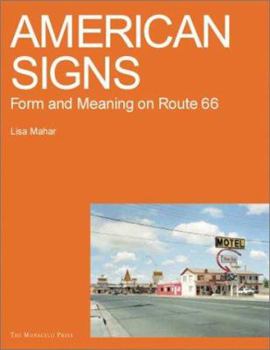
American Signs: Form and Meaning on Route 66

Select Format
Select Condition 
Book Overview
The roadside sign has become an American icon: a glowing neon symbol of the golden age of the open road. Yet signs are complex pieces of design, serving not only as physical markers but also as cultural, political, and economic ones. In American Signs, Lisa Mahar traces the evolution of motel signs on Route 66 in a distinctive visual approach that combines text, images, and graphics. American Signs reveals the rich vernacular traditions of motel sign-making in five eras, spanning from the late 1930s through the 1970s. The motel signs of the early 1940s, for instance, reflect vernacular traditions dating back at least a century, while examples from the later years of the decade reveal a culture newly obsessed with themes. America's fascination with newness and technological progress is manifested in 1950s motel signs. Finally, in the 1960s, a turn toward simplicity and the use of new, modular technologies allowed motel signs to address the needs of a mass society and the beginnings of a national, rather than regional, aesthetic for motel signs.
Format:Paperback
Language:English
ISBN:1580931197
ISBN13:9781580931199
Release Date:October 2002
Publisher:Monacelli Press
Length:272 Pages
Weight:1.90 lbs.
Dimensions:0.7" x 7.1" x 9.1"
Customer Reviews
5 ratings
Signs of the times...
Published by Thriftbooks.com User , 18 years ago
This book illustrates, with some technical form, the artful, whimsical commercial signage of days past. If you're wistful or nostalgic about the wild neon and bright painted signage you saw or like from the golden ages of the fifties and sixties, this book is for you! It's chock full of signage, specs and discussions of the form and substance of fanciful advertising. I highly recommend it to anyone who loves the imagery found all along the Mother Road..and beyond!
Read this and learn how to look at and think about a sign
Published by Thriftbooks.com User , 20 years ago
Every once in awhile someone from the high culture descends into a part of the low culture, studies it, and comes up with interesting findings. That Lisa Mahar is from the high culture there can be no doubt for she has won numerous awards from AIA, NEA, the NYS council on the arts, etc. That she has come up with another subject of interest (her book on grain elevators being a classic) there can be no doubt. In this instance, a book about motel signs, she gathered from her vast collection (500+) of pictures and old post cards the most interesting motel signs on route 66. She culled the ones that showed best her ideas of the evolution, and development of motel signs in terms of form, materials, orientation, symbols, content, and context. When you finish reading her book, you'll recognize streamline from art deco and colonial from international styles. You will know the possible deep embedded meanings in angled forms, irregular shapes, abstract symbols (like the Holiday Inn signs with that shooting star) and the artistic significance of asymmetry. Some of these deep meanings are frightening, if true as claimed by her, especially the crowns, turrets, shields, arrows, and crests in the context in which they appeared, the 1965 Watts insurrection and the 1967 Newark rebellion. Once you have read and reviewed this book, you will never be able to just look at a road sign again. Instead you will think about them - who made them, when, why, and out of what, as well as the overt and covert meanings. Most importantly, you will think how the sign fits in and reflects the place, culture, and tenor of its time.
what a great book.
Published by Thriftbooks.com User , 21 years ago
It is very possible that this book was actually written for me. As designer, it talks about nerdy things that I actually care about. Shapes, construction, and typography of signage.
A must have
Published by Thriftbooks.com User , 23 years ago
This book is a must have for architects, designers, and fans of Route 66! Mahar's careful and inspired approach and method is encouraging and inspiring. Her analysis provides an insight that embraces and transcends the material. The book creates a record of 'The Road,' the nation, and vernacular culture. This complete and multi-discipline analysis provides massive visual and textual interest. The book is organized chronologically in a consistent way, highlighting the developments and changes that occured in Route 66's motel signage and culture. The whole study can also be viewed as a microcosm of the changes that occured in America during the period covered (40's - 70's). The graphics, photographs and writing will appeal to fans of Tufte's books on visual comminication, Venturi's Learning from Las Vegas, and Glassie's Folk Housing in Middle Virginia.
American Signs: Form and Meaning on Route 66
Published by Thriftbooks.com User , 23 years ago
A scholarly study of vintage motel signs on an abandoned highway may sound absurd, but architect Lisa Mahar draws you into her obsessive quest. She spent eight years on research and layout--driving, photographing, and analyzing the shifts in style over the 35-year heyday of what was once America's most celebrated artery. It celebrates a vanished era of local sign makers who had pride of craft and a responsiveness to location, in contrast to the standardization of corporate logos. Mahar's analysis of geometry and iconography is fascinating. (Michael Webb is the book reviewer for LA Architect magazine.)
Copyright © 2026 Thriftbooks.com
Terms of Use | Privacy Policy | Do Not Sell/Share My Personal Information | Cookie Policy | Cookie Preferences | Accessibility Statement
ThriftBooks ® and the ThriftBooks ® logo are registered trademarks of Thrift Books Global, LLC
ThriftBooks ® and the ThriftBooks ® logo are registered trademarks of Thrift Books Global, LLC
