


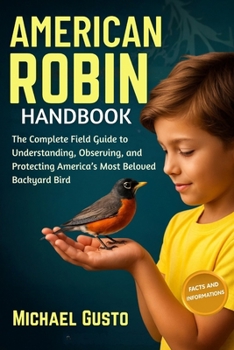
American Robin Handbook: The Complete Field Guide to Understanding, Observing, and Protecting America's Most Beloved Backyard Bird
No Customer Reviews

Introduction to the American Robin
The American Robin is far more than a familiar backyard visitor; it is one of the most emotionally recognizable wildlife companions shared across North America. For generations, this red-breasted thrush has appeared in childhood memories, seasonal transitions, poems, early-morning soundscapes, and the gentle rhythms of daily life. When spring sunlight softens winter's edge and the ground thaws just enough for earthworms to rise, the robin is often the first wild creature to step boldly into view. Its presence carries a comforting certainty - a reminder that nature continues its ancient cycles regardless of human noise, pressure, or pace. This chapter serves as a warm invitation into the rich world of the American Robin, revealing why this species captures hearts and provokes a kind of quiet admiration wherever it is found.
From the moment a robin hops across a lawn, tail lifted slightly as it listens for the faint movement of prey beneath the soil, people feel an instinctive connection. The bird's behaviors are familiar yet endlessly fascinating, blending predictability with surprise in ways that invite observation. The shift of its head, the tilt of its beak, the soft whistled song at dawn - each action reveals intelligence, alertness, and a survival wisdom shaped by thousands of generations. Few birds demonstrate this balance of everyday familiarity and ecological mastery as gracefully as the American Robin. In a very real sense, robins have become ambassadors for the wild world that surrounds us, serving as approachable examples of natural beauty living right at our doorsteps.
To understand why the American Robin resonates so deeply with people, it helps to appreciate the species' unique place in North American culture. The robin serves as a messenger of seasons, especially spring. Its early songs signal the return of warmth and longer days, stirring emotions people might not even realize they carry - hope, renewal, and a sense of fresh beginnings. Even those who do not consider themselves birdwatchers often pause when they hear that familiar, melodious chorus drifting through morning air. The robin's voice becomes a soundtrack to outdoor chores, quiet walks, children's play, and the first cup of coffee on the porch. Such moments, although simple, leave lasting impressions that help shape the bond between humans and this species.
A Bird Rooted in Everyday Life
One of the American Robin's most compelling qualities is how effortlessly it blends into human spaces without losing its wild essence. Unlike elusive forest species, robins are comfortable nesting near homes, living under the eaves of porches, and feeding across open lawns and gardens. Their confidence allows people to observe their daily lives from just a few feet away. Watching a robin tug an earthworm from the soil, gather nesting materials, or feed its hungry fledglings provides a kind of quiet entertainment that feels both intimate and universal. This accessibility is a key reason why so many people feel a personal connection to the species.
Despite this closeness, robins remain deeply connected to true wilderness. Their migration journeys span vast landscapes, from Arctic-edge breeding territories to mild southern winters. Their adaptability allows them to live in forests, mountains, suburbs, and even bustling urban neighborhoods. In every setting, they bring a sense of natural continuity and calm. This blend of wild resilience and neighborly familiarity creates a character that feels almost symbolic - a creature that belongs to both the untamed world and the human experience.
The American Robin is far more than a familiar backyard visitor; it is one of the most emotionally recognizable wildlife companions shared across North America. For generations, this red-breasted thrush has appeared in childhood memories, seasonal transitions, poems, early-morning soundscapes, and the gentle rhythms of daily life. When spring sunlight softens winter's edge and the ground thaws just enough for earthworms to rise, the robin is often the first wild creature to step boldly into view. Its presence carries a comforting certainty - a reminder that nature continues its ancient cycles regardless of human noise, pressure, or pace. This chapter serves as a warm invitation into the rich world of the American Robin, revealing why this species captures hearts and provokes a kind of quiet admiration wherever it is found.
From the moment a robin hops across a lawn, tail lifted slightly as it listens for the faint movement of prey beneath the soil, people feel an instinctive connection. The bird's behaviors are familiar yet endlessly fascinating, blending predictability with surprise in ways that invite observation. The shift of its head, the tilt of its beak, the soft whistled song at dawn - each action reveals intelligence, alertness, and a survival wisdom shaped by thousands of generations. Few birds demonstrate this balance of everyday familiarity and ecological mastery as gracefully as the American Robin. In a very real sense, robins have become ambassadors for the wild world that surrounds us, serving as approachable examples of natural beauty living right at our doorsteps.
To understand why the American Robin resonates so deeply with people, it helps to appreciate the species' unique place in North American culture. The robin serves as a messenger of seasons, especially spring. Its early songs signal the return of warmth and longer days, stirring emotions people might not even realize they carry - hope, renewal, and a sense of fresh beginnings. Even those who do not consider themselves birdwatchers often pause when they hear that familiar, melodious chorus drifting through morning air. The robin's voice becomes a soundtrack to outdoor chores, quiet walks, children's play, and the first cup of coffee on the porch. Such moments, although simple, leave lasting impressions that help shape the bond between humans and this species.
A Bird Rooted in Everyday Life
One of the American Robin's most compelling qualities is how effortlessly it blends into human spaces without losing its wild essence. Unlike elusive forest species, robins are comfortable nesting near homes, living under the eaves of porches, and feeding across open lawns and gardens. Their confidence allows people to observe their daily lives from just a few feet away. Watching a robin tug an earthworm from the soil, gather nesting materials, or feed its hungry fledglings provides a kind of quiet entertainment that feels both intimate and universal. This accessibility is a key reason why so many people feel a personal connection to the species.
Despite this closeness, robins remain deeply connected to true wilderness. Their migration journeys span vast landscapes, from Arctic-edge breeding territories to mild southern winters. Their adaptability allows them to live in forests, mountains, suburbs, and even bustling urban neighborhoods. In every setting, they bring a sense of natural continuity and calm. This blend of wild resilience and neighborly familiarity creates a character that feels almost symbolic - a creature that belongs to both the untamed world and the human experience.
Format:Paperback
Language:English
ISBN:B0G5K9N58B
ISBN13:9798277622001
Release Date:December 2025
Publisher:Independently Published
Length:194 Pages
Weight:0.59 lbs.
Dimensions:0.4" x 6.0" x 9.0"
Related Subjects
Animals Pets Pets & Animal Care Science Science & Math Science & Scientists Science & Technology TravelCustomer Reviews
0 rating
Copyright © 2026 Thriftbooks.com Terms of Use
| Privacy Policy | Do Not
Sell/Share My Personal Information | Cookie Policy | Cookie Preferences | Accessibility Statement
ThriftBooks® and the ThriftBooks® logo are registered trademarks of Thrift Books Global, LLC
ThriftBooks® and the ThriftBooks® logo are registered trademarks of Thrift Books Global, LLC
