


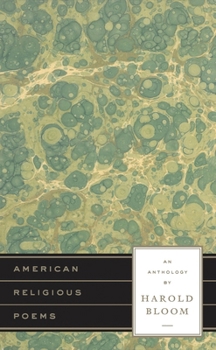
American Religious Poems: An Anthology by Harold Bloom: A Library of America Special Publication


Select Format
Select Condition 
Book Overview
No more profound and intimate expression of America's spiritual life can be found than the work of its poets. From Anne Bradstreet to the Beats, from Native American chant and Shaker hymnody to Walt... This description may be from another edition of this product.
Format:Hardcover
Language:English
ISBN:193108274X
ISBN13:9781931082747
Release Date:October 2006
Publisher:Library of America
Length:900 Pages
Weight:1.40 lbs.
Dimensions:1.3" x 5.4" x 8.5"
Age Range:18 years and up
Grade Range:Grade 12 and higher
Customer Reviews
5 ratings
wonderful anthology
Published by Thriftbooks.com User , 16 years ago
this is the reason we use the word - sensational! Wow - who better than bloom to put this together? God hath all life, glory, goodness, blessedness, in and of himself; and is alone in and unto himself all-sufficient, not standing in need of any creatures which he hath made, nor deriving any glory from them, but only manifesting his own glory in, by, unto, and upon them. He is the alone fountain of all being, of whom, through whom, and to whom are all things; and hath most sovereign dominion over them, to do by them, for them, or upon them whatsoever himself pleaseth. In his sight all things are open and manifest, his knowledge is infinite, infallible, and independent upon the creature, so as nothing is to him contingent, or uncertain. He is most holy in all his counsels, in all his works, and in all his commands. To him is due from angels and men, and every other creature, whatsoever worship, service, or obedience he is pleased to require of them.
Poetry containing worlds
Published by Thriftbooks.com User , 18 years ago
This anthology is another one of Bloom's fantastic encyclopediac projects. He and his assistant Sam Zuba selected nine- hundred poems of two - hundred poets to represent the work of more than three - hundred years of American poetry. While the first part of the work deals with devotional poetry Bloom's heart is with the Emersonian revolution, and its greatest poet, Whitman. The traditional categories are cast aside and the American cosmic religion goes forth into the world containing universes. This anthology too contains universes in which poets of diverse religious traditions have their say. It also contains a very strong, some might say , too strong representation of naysayers or those who are not ordinarily associated with conventional religion at all. David Gates in his 'Newsweek' review notes. " His poets include Christians, Jews and Muslims, as well as all the whatevers; he also has American Indian songs and chants and African-American spirituals. "The Criteria of Political Correctness," he writes, "I dismiss with weary contempt." Go ahead and laugh, but I'll bet the Great Enjoyer really does enjoy it all." Marilynn Robinson however finds that this all- encompassingness raises a certain problem. "Given all this, Harold Bloom's introduction to American Religious Poems seems at odds with its content. He takes the view that there is a sui generis American religion which bears no relation to religion elsewhere and which is obdurately simpleminded. Yet most American poets who are held in high regard are represented here, and there is a preponderance of modern and contemporary poetry. In other words, aside from the rather perfunctory selection of early writing and a few songs and hymns that seem to have been chosen for their familiarity rather than for their interest as poetry, most of the work collected here is thoughtful and sophisticated by any standard. Much of it would seem "religious" only in a context that encouraged the reader to consider it in this light. Yet in this light it is indeed religious." It seems to me that while Bloom might be easily open to criticism on his conception of what Religion is he cannot really be faulted for his great passion for and understanding of Poetry. In fact it is far to say Poetry is Bloom's Religion. And therefore the enthusiasm and love he brings to reading it, and this especially in regard to Whitman and Dickinson, works as pervasive spirit in the volume as a whole. Morever there is so much fine work in this anthology each and every reader will be able to find in it poetry which sustains and inspires.
poetry paradise
Published by Thriftbooks.com User , 19 years ago
Here under one cover is a poetry lover's gold mine --over 900 poems, by over 200 poets, about all things religious. Bloom and Zuba have defined religion very broadly both in terms of faith traditions and subject matter, the skeptical and the unconventional included, the result being poems and poets that reflect the diverse and plural religious perspectives in American history, including Native American, African American, Buddhist, Sufi, Deist, Jewish, Unitarian, Protestant, Catholic and dozens more. The poems are arranged chronologically, beginning with the 1640 Bay Psalm Book (the first book printed in the colonies) and ending with Brett Foster (b. 1973) of Wheaton College. After the 900-plus poems there are 14 American Indian Songs and Chants, then 14 Spirituals and Anonymous Hymns (eg, "Didn't My Lord Deliver Daniel" and "Free at Last"). A reader's guide to religious terms, an name index of poets, and an index of poem titles and first lines complete the volume. I was disappointed in Bloom's "introduction," which was little more than a short, technical essay on Walt Whitman ("our prime shaman of American religion") and Emily Dickinson ("Whitman's only possible rival in American poetry"). A broader treatment would have served a general readership better. Nor is there any introduction to the poets or their poems, save their date of birth. Still, this is a literary treasure trove, and I was sorry I had to return it to the public library; between its two covers there is enough poetry for a lifetime of meditation and reflection.
America's Spiritual Journey in Poetry
Published by Thriftbooks.com User , 19 years ago
Poetry remains the most reliable guide to the thoughts, ideals, and aspirations of the heart. In the recent anthology, "American Religious Poems", the Library of America offers a revealing overview of the many and varied ways in which Americans have expressed their feelings of religion and spirituality through poetry. The anthology includes a cross-section of American religious verse beginning with the American Indians and the Pilgrims, and it continues chronologically through poets born in the final third of the Twentieth Century. Selections from over 200 poets are included in over 600 pages of verse together with provocative essays by the editors of the collection, Professor Harold Bloom and Jesse Zuba. The Library of America anthology invites attention to the diversity of American experiences of religion, but it suggests large areas of continuity as well. From earliest times, Americans have been more preoccupied with religion than have been Europeans. Many of the early settlers came to America to avoid religious prosecution and their influence has been lasting. With the independence of the United States, many people developed a sense of American uniqueness and purpose to which they gave expression in poetry and literature. In addition, the freedom and liberty that Americans have enjoyed shapes their various and individual approaches to religion. It is tempting, when faced with an anthology of poetry of the scope of this collection, to browse and to read selectively from time to time from among the wealth of the selections. This method of reading would be an entirely proper way to approach "American Religious Poems" ; but in my own reading, I gained a great deal by the cumulative impact of reading the book from cover to cover. It gave me the feeling of a multitude of voices using different poetical forms over the years to converse with each other about feelings and matters they found of highest significance to them. The weight and the flow of Americans creating poetry about religious subject will be missed by browsing through the collection. The book includes poetry by adherents of many religions, Puritan, Protestant, Catholic, Jewish, Buddhist, Moslem, Bah'ai, native American, and others. Some of the poems reflect a comfort with the doctrines and practices of a specifc religion. But probably the greater number of poems show a questioning of and a skepticism for the teachings of traditional religion. They show that America long has been home to a religion of spirituality, which tends to be inwardly based, highly personal, and suspicious of creeds and doctrines. In his introduction, Harold Bloom argues that American poetry as a whole shows a distinctively American religious sensibility which is developed at its fullest in Walt Whitman and in the two other poets, Emily Dickinson and Hart Crane, that, Bloom argues, constitute the "grandest voices" of American poetry. There is a great mix of the familiar and the unfamiliar in this
A beatifully put together book and a richly rewarding anthology
Published by Thriftbooks.com User , 19 years ago
This is a particularly beautiful book. It is handsomely printed and bound and even has a decorative slipcase. That is delightful to look at and hold (while being durable) is quite important for a large anthology because it is a volume you will return to again and again over many years. It is also beautiful because of its contents. The hundreds of poems written by more than two hundred poets from the sixteenth century to the present offer a galaxy of religious expression. However, the word "religious" needs to be given some sort of frame for the reader to understand what this book is about. As the subtitle notes, this anthology was put together by the critic, Yale professor, and author, Harold Bloom. Some of his richest ideas, that he returns to often, involve the ideas of creative misreading, the power of literary figures to reshape human sense of self (consciousness), and also the idea of the American Religion. That is, the use and interpretation of religious imagery, doctrines, thoughts, and emotions through the lens of the American identity and character. While this is not something I can present to you here, there is a wonderful essay by Bloom to open the volume and that can help you understand how these poems were selected and what they represent in Bloom's scheme of things. For him (as he notes on page xlv), "Whitman was our Homer, Dickinson our Shakespearean lyricist, Crane our Pindar, and Emerson our Plato". This gives you a strong idea what he is thinking about. What this book is not is a collection of devotional poems. Certainly the poems are not orthodox meditations of any particular sect or creed. There are a few overtly traditionally religious poems, but most are poems of hope, meditations on topics such as death and aspects of the human condition, expressions of ecstasy, powerful uses of traditional religious imagery for very human poems, and just about anything you can think of that could be connected in some way to the broader American experience of religion. Given Bloom's emphasis on the idea of "The American Religion" (he even wrote a book of that title), a more appropriate title of this book might have been "Poems of the American Religion". This would have avoided the need for the disclaimer I gave in the last paragraph, but would have probably raised more questions about what the American Religion is. However, given the nature of the selections, that is a necessary question. Again, Bloom addresses this well in the opening essay. While America is an overtly religious country, regardless of the efforts of some to make that not so, there is an increasing ignorance of certain religious ideas and symbols. There is a section in the back of the book that explains certain terms and ideas. There is also a list of sources, a few notes on the text, an index of poets by name, and an explanatory note by Jesse Zuba in the front that sets out the goals and purpose of the volume. The poems are arranged chronologically
Copyright © 2026 Thriftbooks.com Terms of Use
| Privacy Policy | Do Not
Sell/Share My Personal Information | Cookie Policy | Cookie Preferences | Accessibility Statement
ThriftBooks® and the ThriftBooks® logo are registered trademarks of Thrift Books Global, LLC
ThriftBooks® and the ThriftBooks® logo are registered trademarks of Thrift Books Global, LLC
