


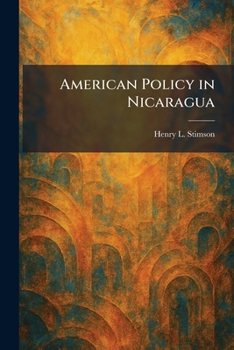
American Policy in Nicaragua

"American Policy in Nicaragua" provides an authoritative and contemporary account of the United States' diplomatic and military involvement in Nicaragua during the early 20th century. Written by Henry L. Stimson, who served as a special envoy to the region, this work offers a primary perspective on the complexities of Central American politics and the motivations behind American interventionism.
The text details the volatile political climate of the 1920s, exploring the civil unrest and the subsequent efforts to establish a stable government through the Tipitapa Agreement. Stimson examines the strategic interests of the United States, the application of the Monroe Doctrine, and the challenges of fostering democratic processes in a period of intense regional instability. This book serves as a critical historical document for understanding the evolution of U.S. foreign policy in Latin America and the long-term impact of diplomatic mediation.
"American Policy in Nicaragua" remains an essential resource for students of international relations, political science, and American history, providing deep insight into the justifications and implementation of foreign policy during a pivotal era of global expansion.
This work has been selected by scholars as being culturally important, and is part of the knowledge base of civilization as we know it. This work was reproduced from the original artifact, and remains as true to the original work as possible. Therefore, you may see the original copyright references, library stamps (as most of these works have been housed in our most important libraries around the world), and other notations in the work.
This work is in the public domain in the United States of America, and possibly other nations. Within the United States, you may freely copy and distribute this work, as no entity (individual or corporate) has a copyright on the body of the work.
As a reproduction of a historical artifact, this work may contain missing or blurred pages, poor pictures, errant marks, etc. Scholars believe, and we concur, that this work is important enough to be preserved, reproduced, and made generally available to the public. We appreciate your support of the preservation process, and thank you for being an important part of keeping this knowledge alive and relevant.
Customer Reviews
ThriftBooks® and the ThriftBooks® logo are registered trademarks of Thrift Books Global, LLC
