


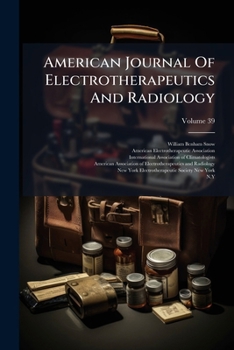
American Journal Of Electrotherapeutics And Radiology; Volume 39

Select Format
Select Condition 
Book Overview
Explore the historical landscape of electrotherapeutics and radiology with the "American Journal Of Electrotherapeutics And Radiology, Volume 39." This volume offers a unique glimpse into the practices and perspectives of early 20th-century medical professionals involved in electrotherapy, climatology, and radiology. Featuring contributions from the American Electrotherapeutic Association, the International Association of Climatologists, and other leading societies, this journal provides invaluable insights into the development and application of these medical fields.
Delve into detailed articles, case studies, and discussions that highlight the state-of-the-art techniques and the evolving understanding of therapeutic methods. Whether you are a medical historian, a practitioner of alternative medicine, or simply curious about the roots of modern medical practices, this journal offers a rich and fascinating read. Discover the enduring legacy of pioneers like William Benham Snow and gain a deeper appreciation for the advancements in electrotherapeutics and radiology.
This work has been selected by scholars as being culturally important, and is part of the knowledge base of civilization as we know it. This work was reproduced from the original artifact, and remains as true to the original work as possible. Therefore, you will see the original copyright references, library stamps (as most of these works have been housed in our most important libraries around the world), and other notations in the work.
This work is in the public domain in the United States of America, and possibly other nations. Within the United States, you may freely copy and distribute this work, as no entity (individual or corporate) has a copyright on the body of the work.
As a reproduction of a historical artifact, this work may contain missing or blurred pages, poor pictures, errant marks, etc. Scholars believe, and we concur, that this work is important enough to be preserved, reproduced, and made generally available to the public. We appreciate your support of the preservation process, and thank you for being an important part of keeping this knowledge alive and relevant.
Customer Reviews
ThriftBooks® and the ThriftBooks® logo are registered trademarks of Thrift Books Global, LLC
