


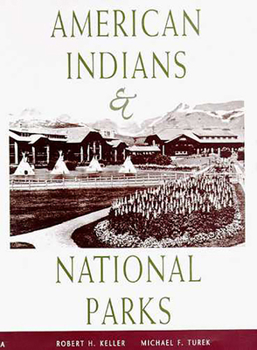
American Indians & National Parks


Select Format
Select Condition 
Book Overview
Many national parks and monuments tell unique stories of the struggle between the rights of native peoples and the wants of the dominant society. These stories involve our greatest parks--Yosemite, Yellowstone, Mesa Verde, Glacier, the Grand Canyon, Olympic, Everglades--as well as less celebrated parks elsewhere. In American Indians and National Parks, authors Robert Keller and Michael Turek relate these untold tales of conflict and collaboration. American Indians and National Parks details specific relationships between native peoples and national parks, including land claims, hunting rights, craft sales, cultural interpretation, sacred sites, disposition of cultural artifacts, entrance fees, dams, tourism promotion, water rights, and assistance to tribal parks. Beginning with a historical account of Yosemite and Yellowstone, American Indians and National Parks reveals how the creation of the two oldest parks affected native peoples and set a pattern for the century to follow. Keller and Turek examine the evolution of federal policies toward land preservation and explore provocative issues surrounding park/Indian relations. When has the National Park Service changed its policies and attitudes toward Indian tribes, and why? How have environmental organizations reacted when native demands, such as those of the Havasupai over land claims in the Grand Canyon, seem to threaten a national park? How has the Park Service dealt with native claims to hunting and fishing rights in Glacier, Olympic, and the Everglades? While investigating such questions, the authors traveled extensively in national parks and conducted over 200 interviews with Native Americans, environmentalists, park rangers, and politicians. They meticulously researched materials in archives and libraries, assembling a rich collection of case studies ranging from the 19th century to the present. In American Indians and National Parks, Keller and Turek tackle a significant and complicated subject for the first time, presenting a balanced and detailed account of the Native-American/national-park drama. This book will prove to be an invaluable resource for policymakers, conservationists, historians, park visitors, and others who are concerned about preserving both cultural and natural resources.
Format:Paperback
Language:English
ISBN:0816520143
ISBN13:9780816520145
Release Date:May 1999
Publisher:University of Arizona Press
Length:319 Pages
Weight:1.17 lbs.
Dimensions:0.8" x 6.2" x 9.3"
Customer Reviews
5 ratings
Good coverage of the topic, but not the best coverage of it
Published by Thriftbooks.com User , 16 years ago
This is one of three books on Native Americans and the national parks that appeared within a few years of one another. (The other two are by Mark David Spence and Philip Burnham.) All three are good books, but this is the weakest of the three. If you're looking to read just one book, I'd recommend Spence; but if you are willing to invest the time in three books on the topic, you should definitely read this one too. Topical coverage varies a bit. This one covers several topics neglected elsewhere, notably Wisconsin and the Olympic Peninsula. Though all three books discuss Grand Canyon and the many Navajoland parks, this one has the fullest coverage of that region. All these books express a pro-forma sympathy for American Indians. All express that sympathy in the language of sympathetic whites from the 1960s and 1970s. None engage the wider literature on American Indian Studies that has grown considerable in the last 25 years or so. However, Spence and Burnham engage wider literatures on the national parks and on the construction of wilderness, and I recommend them on that basis. Keller and Turek are the least tied to academic research, and most obviously dependent on interviews with both tribes and park management. These interviews mean that they were able to write their stories up to the events current when they visited each park. Unfortunately, they often heard the most about the not-yet-resolved issues, so many of their stories are left hanging without resolution. (Some have since reached a denouement, while others have not.)
Well researched history of intergovernmental relationships
Published by Thriftbooks.com User , 16 years ago
This is a thorough snapshot of several case studies, showing how tribes and national parks have certainly had their share of disagreements. Much of the history focuses on the early years of the NPS, when white American culture was pretty insensitive to just about every other culture around. But the case studies reveal that many of the issues are as current today as they were back then, with our approaches to governmental decisions still not fully recognizing tribal values or issues from that perspective. It goes both ways, of course. The book is careful not to put tribal values on a pedestal; people are people, and we struggle with economy versus the environment, protection of resources versus protection of recreation, and the desires of locals versus those of the general masses, no matter what the color of our skin is. These are not necessarily tribal issues but generic struggles everywhere. As a park manager, the book helped me see several ways of looking at park values, land use and acquisition policies and purposes from several perspectives. A good read, lots of thought provoking studies that are not discussed in modern circles.
Further light on a subject previously ignored
Published by Thriftbooks.com User , 21 years ago
The National Park Service, throughout most of its history, has treated American Indians as museum pieces suspended in time - colorful, nostalgic versions of environmentalists (239-242). In books about national parks, even as late as 1989, Native Americans were seen as artifacts and scenery more than people. To correct this oversight, Robert Keller and Micheal Turek add a much-needed chapter to Native American history with their book American Indians and National Parks. Keller and Turek explain that the relationship between American Indians and the National Park Service has been one fraught with contradiction and exploitation. Surprisingly, the official policy of Congress since the 19th century has been to promote American Indians and protect their welfare (18). As in nearly all areas of the United States, the contrary happened to Indians in national parks. Philetus Norris, the second superintendent of Yellowstone National Park, in his order for Indian expulsion, decreed that park land was not Indian country, that Indians feared geysers and that Yellowstone is "for the use and enjoyment of all Americans" (24). Early national park leaders felt pressure to conform to popular ideals of nature. Those perceptions excluded Native Americans, which fell decidedly against the notion that national parks were for the use and enjoyment of all Americans and official Congressional policy. How could national parks claim to be created for the enjoyment all Americans when they shunned the first Americans - American Indians? Another way Congress's directive towards Native Americans became contradicted was in the National Park Service's presentation of Indian history through its interpretive programs. Mesa Verde National Park's programs exclude Ute history, largely because of ongoing disputes with the tribe over land issues. Interpretation of modern Indian life in national parks has been an afterthought (42). Early park directors and superintendents knew little about natives (28). Native American names abound in national parks, but many of their meanings are mute to visitors. Only in the last 15 years has the NPS increased its awareness and sensitivity towards American Indians, but bitterness still prevails as past wounds slowly heal. Economic exploitation of national parks even affected Native Americans. Concessionaires used tribal images of the Blackfeet, whose ancestral land became Glacier National Park, in park promotion. Louis Hill, president of the Great Northern Railroad featured images of Blackfeet warriors to proliferate the Indian mystique on the railroad's advertisements, calendars and in lodge décor. Hill hired natives to perform for tourists by drumming, dancing and signing postcards. Hill directed the natives to be friendly, "have good costumes, put on a good show, and live in peace and harmony" (57). The Blackfeet became a living exhibit for park visitors when Hill directed a few tribal families to inhabit teepees on the lawn of the East Glacier
Must Read
Published by Thriftbooks.com User , 24 years ago
(Planeta.com Journal) - One of the most influential books this year, this work examines the relationship of parks and Indian cultures. Remarkably, this story has not been well told -- until now. The authors point out that "one can find thousands of books about American Indians, a considerable body of literature about natural parks, but almost nothing linking the two." The book draws on extensive research and more than 200 interviews with Native Americans, environmentalists, park rangers and politicians. It also asks important questions such as what are the obligations owed to those displaced by park creation and do aboriginal people have special rights to their homelands. This book is one of the year's must reads.
Highly recommended contribution to Native American studies.
Published by Thriftbooks.com User , 26 years ago
Beginning with Yosemite and Yellowstone, American Indians & National Parks explains how the creation of these two oldest national parks affected native peoples and set a pattern followed with the subsequent creations of Apostle Islands National Lakeshore; Canyon de Chelly; Chaco Culture National Historical Park; Death Valley National Monument; Everglades National Park; Glacier National Park; Glen Canyon; Grand Canyon National Park; Mesa Verde National Park; Monument Valley Tribal Park; Navajo National Monument; Olympic National Park; Pipe Spring National Monument; Rainbow Bridge National Monument; and Wupatiki National Monument. Robert Keller and Michael Turek collaborate to show how and why the National Park Service changed its policies and attitudes toward Native American tribes, the response of environmental organizations to native demands, and how the park service dealt with native claims to hunting and fishing rights in Glacier, Olympic, and Everglades National Parks. American Indians & National Parks is a carefully researched, ably presented reference that is highly recommended to students of Native American studies, environmentalists, and National Park Service operatives.
Copyright © 2026 Thriftbooks.com Terms of Use
| Privacy Policy | Do Not
Sell/Share My Personal Information | Cookie Policy | Cookie Preferences | Accessibility Statement
ThriftBooks® and the ThriftBooks® logo are registered trademarks of Thrift Books Global, LLC
ThriftBooks® and the ThriftBooks® logo are registered trademarks of Thrift Books Global, LLC
