
Skip to content
Scan a barcode
Scan
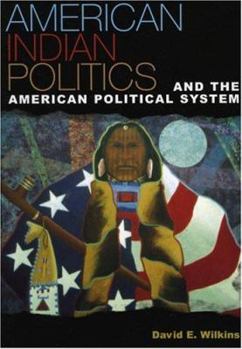
Paperback American Indian Politics and the American Political System (Spectrum Series: Race and Ethnicity in National and Global Politics) Book

ISBN: 0847693066

ISBN13: 9780847693061

American Indian Politics and the American Political System (Spectrum Series: Race and Ethnicity in National and Global Politics)

Select Format

Select Condition ThriftBooks Help Icon

Recommended

Format: Paperback

Condition: Very Good

$7.59
Save $35.36!
List Price $42.95
Almost Gone, Only 2 Left!
Save to List

Book Overview

Since American Indians and Alaskan Natives are the indigenous peoples of North America, why do we fail to acknowledge them as having the first forms of national government? Indian nations are sovereign-they have their own tribal governments, their own separate territories, and they are able to negotiate treaties, exercise taxing authority over persons and businesses in their nations, and operate gambling casinos, among other things. At the same time, the individuals who constitute Native nations have also been declared U.S. citizens subject to congressional legislation, presidential decrees, and rulings by the Supreme Court. The conflict between these two political states of being-and the struggle of Indian nations and tribes to control their own political destiny-form the focal points of this book.

American Indian Politics and the American Political System brings together in one source a comprehensive introduction to the history, structure, and function of tribal governments, their relationship to contemporary American politics, and the rights of individual Indians who are often caught in between these frequently contentious sovereigns. As David E. Wilkins expertly demonstrates, American Indian politics today is an elaborate braid of tribal government, American citizenship, indigenous activism, economic development, media attention, and cultural identity. Here, the many strands of American Indian politics come together in a beautiful and authoritative large format book, reader-friendly in every way. Photos, maps, and highlighted case studies add to the highly visual presentation overall.

Customer Reviews

3 ratings

excellent, authoritative resource

One of the few studies of Native American politics out there today. I teach courses in racial and ethnic politics, and this book is incredibly helpful, not only for the arguments that Wilkins makes, but perhaps even more so because of its comprehensive scope--both historically, and with respect to political behavior *and* institutions.

American Indian Politics .. what a history lesson!

As a descendant of the Lumbee Indians of North Carolina, David Wilkins is the perfect person to write this very informative book. If you are interested in the history of the native American peoples, I recommend that this book is in your reading list.

best textbook treatment of American Indians in US political system

This is an essential text on role of Indians in US political system, designed to be used by undergraduates. The chapters cover just about every issue, including history, demographics, activism, tribal political systems, federal and state policies toward Indians, and the images of Native Americans in national media. The emphasis is on Native Americans within the US political system as a whole, and not on politics within tribes or on reservations. Though the factual material is presented in a balanced way, Wilkins has a clear political position that is evident in every chapter of the text. Among other consequences, this means that he does not take a critical stance toward the tribal governments, political movements, or individual Native Americans that he discusses. In the classroom, this would provide a good foundation for discussion, while the non-classroom reader will simply have to read the book critically. While the bias is a "feature," not a "flaw," the book also has some minor flaws. For examples, uncertain organization mars the chapter on "actors in Indian politics." Rather than focusing narrowly on these actors, Wilkins intersperses his treatment of actors and the history of particular policies. Some of this confusion is inevitable, since the role of the BIA as an actor obviously reflects the legislative history of the agency, but Wilkins does not try to keep these issues analytically distinct. Oddly for a book on politics, Wilkins doesn't discuss tribal political systems all that much. For much better treatment of this issue, albeit one limited to the Montana reservations, see Lopach et al., Tribal Government Today. Despite these weaknesses, this really is the best overall book on American Indian politics that I have been able to find. It would be useful both for the general reader interested in the topic and for undergraduate classroom use.
Copyright © 2026 Thriftbooks.com Terms of Use | Privacy Policy | Do Not Sell/Share My Personal Information | Cookie Notice | Cookie Preferences | Accessibility Statement
ThriftBooks ® and the ThriftBooks ® logo are registered trademarks of Thrift Books Global, LLC

GoDaddy Verified and Secured