


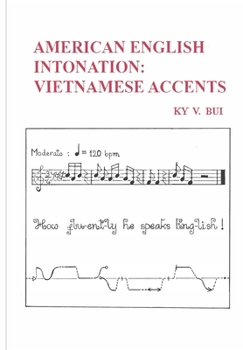
American English Intonation: Vietnamese accents

Select Format
Select Condition 
Book Overview
Common simple or compound sounds, heard in English, are introduced and classified, by nomen-define classification, into colloquial-compose accents, colloquial-intonate accents, critical-emphatic accents, critical-aid accents, front-aid accents, tail-aid accents and critical-mix accents.
A critical-emphatic accent or critical-intonate accent can be classified, by its grammatical, syntactic or punctuative role, as an informative-attention accent, coordinate-list accent, end-clause accent, end-inverseclause accent, interrupt-block accent, inverse-block accent, infinitive-verb accent or colon-introduce accent.
A comprehensive set of colloquial-intonate rules are designed according to which the critical-emphatic syllable of any identified colloquial-intonate word is modulated with a colloquial-intonate accent so as to connote a colloquial-intonate sense that is equivalent to a written punctuative sense indicated or implicated by an inter-word sign- ie. a space, coma, semicolon or hyphen.
The intonation of a front-sentence unit is composed by applying intonative rules on every identified critical or emphatic word to modulate its critical-intonate syllable with a critical emphatic accent represented by a colloquial-intonate symbol, such as an intonate-outline, draft, graph or diacritic symbol, drawn adjacently above or below the same syllable.
The intonation of a tail-sentence unit is composed by applying tail-intonate rules on an identified tail-sentence unit, in the tail-modulate investigation of the tail-characterize treatment of a specified intonative system, to modulate it with a primary or elongative pitch-distribute pattern-ie. a tail-intonate pattern represented by a glissando or slur-ie. a 3-pitch transition.
The intonation of a whole written statement, made up of the intonations of a front and tail-sentence units, is illustrated by an intonative illustrative diagram made up of colloquial intonative symbols concatenated or interconnected with straight-dash lines marked with intonative markers-ie. a vertical bar or arrow head- at critical points.
A practical application of intonative rules or diagrams is illustrated or explained in the following circumstance or example:
As an American speaks English in a hurry, he happens to pronounce an inter-word pause as equally long as inter-syllable pause. Because the original inter-border pattern, formed & observable conspicuously in a specified written statement, is lost or becomes obscure in the corresponding spoken statement; so, it is impossible to recognize each separate constituent word of the spoken statement.
In order to restore the original inter-border pattern as well as to aid in textual recognition, each hidden interword border, located thruout the whole statement, should be marked out conspicuously according to the following scheme:
After conducting such aid-recognition scheme, because every interword border becomes conspicuous again; so, every separate word of the spoken statement can be identified clearly so as to understand its meaning.
Customer Reviews
ThriftBooks® and the ThriftBooks® logo are registered trademarks of Thrift Books Global, LLC
