


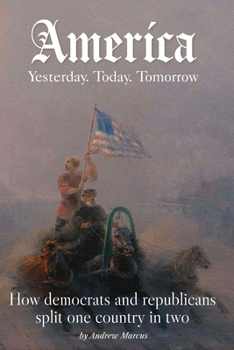
America. Yesterday, today, tomorrow: How democrats and republicans split one country in two

America: Yesterday, Today, Tomorrow is a nonfiction book about the United States written in the genre of an intellectual historical essay. It brings together history, economics, politics, and culture into a single analytical narrative that explains why America has become what we see today and which internal mechanisms shape its development.
Unlike most books about America, which are based either on travel impressions or ideological commentary, this work avoids taking a partisan stance and examines the country as a complex, contradictory, yet internally coherent historical project. The author aligns with neither Democrats nor Republicans and argues that contemporary America is divided into two camps, both of which rely on propaganda and manipulation in their struggle for power and votes.
The book consists of three parts.
The first part (Yesterday) is devoted to the origins of the American state. U.S. history is presented in a popular-science and analytical manner. Through the figures of the Founding Fathers, colonial wars, slavery, and the Constitution, the author shows that America was not originally created as a democracy, but as a republic with a system of checks and balances. The events of the twentieth century - the Great Depression, Roosevelt's reforms, the civil rights movement, and foreign policy conflicts - are examined as the logical development of the country's internal contradictions.
The second part (Today) focuses on contemporary America. The author analyzes migration, deportations, the work of federal agencies, crime, drug trafficking, and racial conflicts. Drawing on statistics and research by sociologists and economists, the book demonstrates that many U.S. problems are structurally similar to crises in developing countries.
The third part (Tomorrow) addresses the future of America. Through an analysis of the American Dream, the condition of cities, the healthcare system, and the growth of social inequality, the author seeks to understand whether a way out of the current crisis is possible. The book concludes with a chapter on Donald Trump as a symbol and culmination of the accumulated contradictions of American society.
Overall, the book offers a coherent and nonpartisan view of the United States as a historical and social phenomenon and is intended for readers interested in understanding how the modern world works.
Related Subjects
History Political Science Politics & Social Sciences Social Science Social SciencesCustomer Reviews
ThriftBooks® and the ThriftBooks® logo are registered trademarks of Thrift Books Global, LLC
