


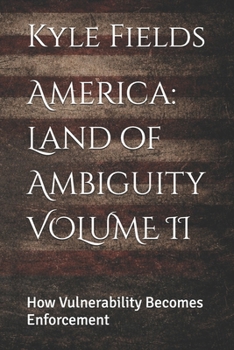
America: Land of Ambiguity VOLUME II: How Vulnerability Becomes Enforcement

America: Land of Ambiguity - Volume II is a documented record of how instability, poverty, homelessness, race, and civic exclusion are managed through American legal and administrative systems from roughly 1990 to 2024.
This book does not argue intent, assign blame, or propose solutions. It examines how ambiguity itself functions as a governing mechanism: conditional rights, unclear obligations, discretionary enforcement, and requirements that are never fully satisfied.
Across multiple domains-economic policy, courts, benefits systems, housing enforcement, credit markets, and voting eligibility-the book traces how vulnerability becomes actionable. Poverty is converted into legal liability. Homelessness emerges as a downstream failure state rather than a discrete crisis. Racialized outcomes persist through formally neutral systems without requiring explicit belief or ideology. Punishment survives punishment through permanent records, financial barriers, and administrative uncertainty.
Drawing on publicly available records, government reports, court rulings, audits, and longitudinal data, this volume documents continuity rather than rupture. Oversight exists. Findings are issued. Reforms are announced. Yet core mechanisms remain intact across administrations and political shifts.
This is not a narrative of villains and heroes. It is a structural account of how systems adapt, persist, and stabilize control without declaration-and how non-action, conditionality, and administrative silence function as outcomes rather than accidents.
America: Land of Ambiguity - Volume II is written as a record: for readers seeking to understand how modern governance manages instability, and why conditions that appear unresolved often remain operational by design.
Customer Reviews
ThriftBooks ® and the ThriftBooks ® logo are registered trademarks of Thrift Books Global, LLC
