


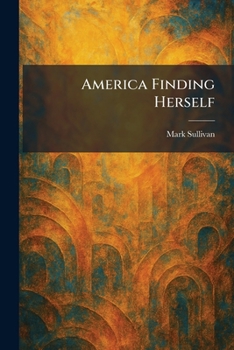
America Finding Herself

"America Finding Herself" is a comprehensive and engaging examination of the social, cultural, and political forces that shaped the United States at the dawn of the twentieth century. As part of Mark Sullivan's landmark series, this work serves as a panoramic chronicle of a nation in transition, capturing the spirit of an era marked by rapid change and the forging of a distinct national identity.
Sullivan moves beyond traditional political history to explore the collective consciousness of the American people. He provides a fascinating look at the educational foundations of the time, particularly the influence of the McGuffey Readers, and how these shared academic experiences created a unified cultural language. The book vividly recreates the atmosphere of the period through its exploration of popular songs, fashions, and the everyday lives of citizens, offering a unique "grassroots" perspective on history.
From the rise of industrial giants to the charismatic leadership of figures like Theodore Roosevelt, "America Finding Herself" traces the emergence of the United States as a modern power. This work is an essential resource for anyone seeking to understand the historical roots of American culture and the socio-economic transformations that defined the early 1900s.
This work has been selected by scholars as being culturally important, and is part of the knowledge base of civilization as we know it. This work was reproduced from the original artifact, and remains as true to the original work as possible. Therefore, you may see the original copyright references, library stamps (as most of these works have been housed in our most important libraries around the world), and other notations in the work.
This work is in the public domain in the United States of America, and possibly other nations. Within the United States, you may freely copy and distribute this work, as no entity (individual or corporate) has a copyright on the body of the work.
As a reproduction of a historical artifact, this work may contain missing or blurred pages, poor pictures, errant marks, etc. Scholars believe, and we concur, that this work is important enough to be preserved, reproduced, and made generally available to the public. We appreciate your support of the preservation process, and thank you for being an important part of keeping this knowledge alive and relevant.
Related Subjects
HistoryCustomer Reviews
ThriftBooks ® and the ThriftBooks ® logo are registered trademarks of Thrift Books Global, LLC
